
Supreme Court Upholds Quashing of Section 148 Notice for Invalid Sanction Under Section 151
# Supreme Court on Section 148 Notice and Section 151 Sanction: Important Ruling on Invalid Reassessment Proceedings
## Introduction
Income Tax reassessment proceedings are an important area of tax litigation because a notice issued under **Section 148 of the Income-tax Act** can reopen an assessment and require the taxpayer to explain the income and transactions of an earlier assessment year. However, the power to reopen an assessment is not unlimited. The Income-tax Act prescribes several statutory conditions that must be fulfilled before reassessment proceedings can validly commence.
One of the important safeguards is the requirement of **specified approval or sanction under Section 151**. The authority competent to grant approval depends upon the applicable statutory provisions and the relevant circumstances of the case. If the approval is obtained from an authority that is not legally competent under the applicable provision, the validity of the reassessment proceedings can become a serious jurisdictional issue.
A recent Supreme Court ruling has once again highlighted the importance of following the statutory requirement relating to sanction under Section 151. The decision is particularly relevant for taxpayers, Income Tax practitioners, Chartered Accountants, advocates and professionals handling reassessment notices, tax appeals and income tax litigation.
The judgment also discusses the effect of the **Taxation and Other Laws (Relaxation and Amendment of Certain Provisions) Act, 2020 (TOLA)** and whether extension of limitation under the relaxation legislation could eliminate or alter the separate statutory requirement of obtaining approval from the prescribed authority.
---
## Understanding Section 148 of the Income-tax Act
Section 148 of the Income-tax Act deals with the issuance of notice for reassessment in cases where the Assessing Officer has information suggesting that income chargeable to tax has escaped assessment, subject to the conditions prescribed by law.
A Section 148 notice is therefore not merely an ordinary compliance notice. It can result in reopening of an earlier assessment and examination of the taxpayer's income for a previous assessment year.
Because reassessment affects the finality of an earlier assessment, the Income-tax Act contains procedural safeguards. These safeguards are intended to ensure that the power of reassessment is exercised according to law and not arbitrarily.
A taxpayer receiving a Section 148 notice should therefore examine not only the allegations relating to escaped income but also the **jurisdictional and procedural requirements** surrounding the notice.
These may include:
* Whether the notice was issued within the applicable limitation period;
* Whether the conditions for reopening were satisfied;
* Whether the proper procedure was followed before issuance of notice;
* Whether the approval or sanction was obtained from the competent authority;
* Whether the notice was issued by the legally authorised officer;
* Whether the applicable statutory provisions were correctly applied;
* Whether the reassessment proceedings are affected by limitation or jurisdictional defects.
---
# Importance of Section 151 Approval
Section 151 provides an important statutory safeguard in reassessment proceedings. It specifies the circumstances in which approval of the prescribed authority is required before an Assessing Officer can issue a reassessment notice.
The purpose of such approval is to introduce an additional level of statutory scrutiny before the taxpayer is subjected to reassessment proceedings.
The requirement is therefore not merely an internal administrative formality.
Where the Act requires approval from a particular authority, the requirement must be examined with reference to the **exact statutory language applicable to the relevant assessment year and the relevant date**.
This is particularly important in cases involving older assessment years and transitional provisions because amendments to reassessment provisions have occurred over time.
---
# What Was the Controversy?
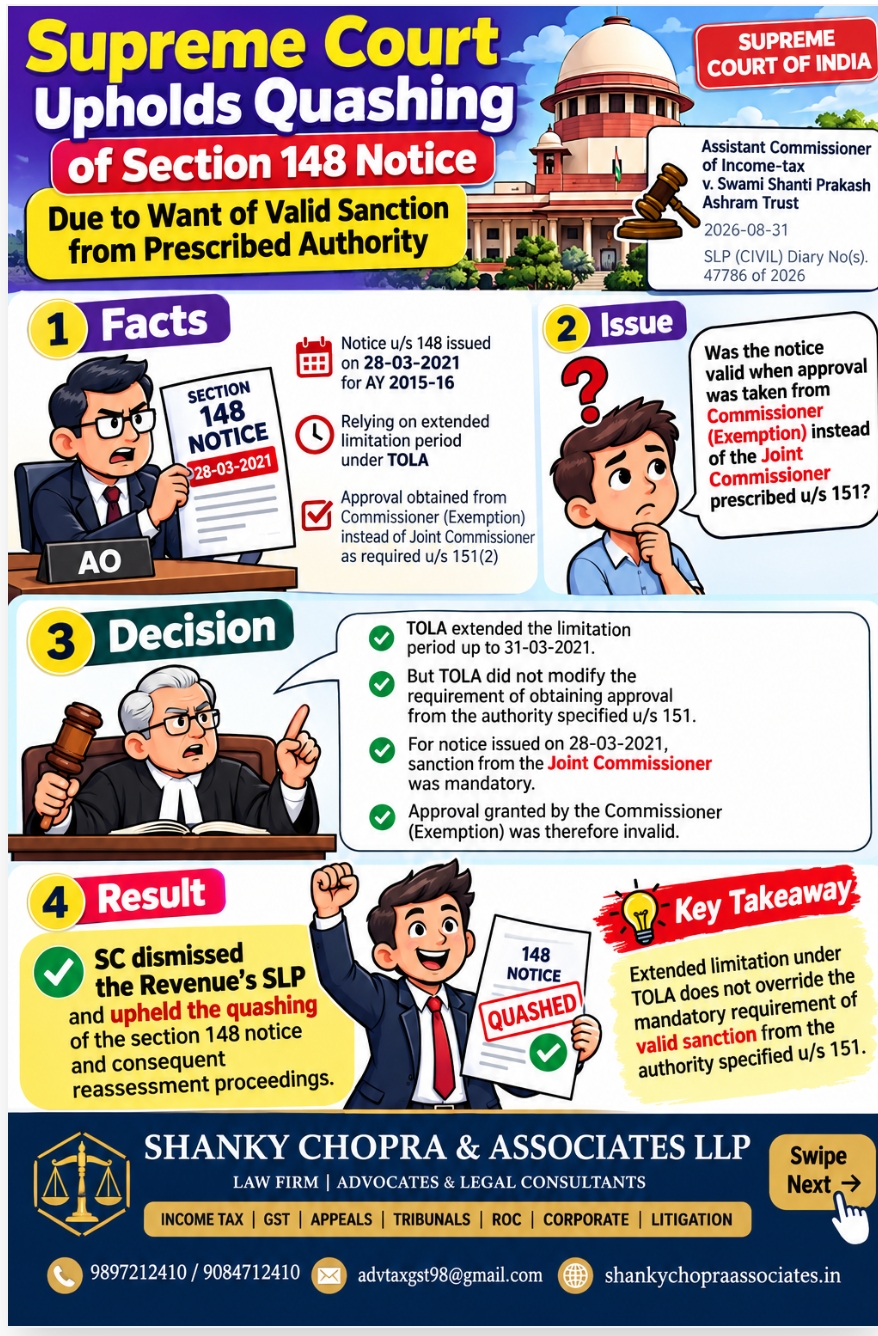
The controversy arose in relation to a Section 148 notice issued for **Assessment Year 2015-16**.
The Assessing Officer issued the reassessment notice on **28 March 2021**.
One of the important issues before the Court was whether the statutory requirement concerning approval under Section 151 had been properly complied with.
The relevant approval had been obtained from an authority which, according to the applicable statutory framework, was not the authority prescribed for granting the necessary sanction in the circumstances of the case.
The taxpayer challenged the reassessment proceedings on this jurisdictional ground.
The matter eventually reached the Supreme Court.
---
# Role of TOLA in Reassessment Proceedings
During the COVID-19 period, Parliament introduced various relaxation measures to deal with statutory and regulatory deadlines that were affected by the extraordinary circumstances.
The **Taxation and Other Laws (Relaxation and Amendment of Certain Provisions) Act, 2020**, commonly known as **TOLA**, extended or relaxed certain statutory time limits.
This created several important legal questions in income tax litigation.
One such question was whether the extension of the limitation period under TOLA could also affect other statutory requirements connected with reassessment proceedings.
The Revenue relied upon the extended limitation framework in relation to the notice issued on 28 March 2021.
However, the taxpayer contended that merely because the period for taking an action had been extended, the statutory requirement concerning approval under Section 151 could not be ignored or replaced.
This distinction became important before the Supreme Court.
---
# Limitation and Sanction Are Different Requirements
One of the key principles emerging from the decision is that **limitation and statutory sanction are separate legal requirements**.
An extension of limitation determines whether a particular action can be taken within the legally permissible period.
However, if the statute separately requires approval from a prescribed authority, that requirement continues to operate unless the law specifically modifies or removes it.
In simple terms:
**Extension of time does not automatically mean extension or alteration of jurisdiction.**
Therefore, even if TOLA allowed the Revenue additional time to issue a notice, the officer still had to comply with the statutory requirements governing the authority competent to grant sanction.
This distinction can be highly relevant in reassessment litigation.
---
# Why Approval From the Correct Authority Matters
The Income-tax Act does not use the requirement of approval merely as a procedural suggestion.
Where the statute specifies a particular authority, the statutory requirement has to be complied with.
Suppose a provision requires approval from Authority A but approval is obtained from Authority B.
The question is not simply whether Authority B is senior or administratively connected with the department.
The legal question is:
**Was Authority B the authority prescribed by the statute for the particular situation?**
If the answer is no, the taxpayer may have a substantial jurisdictional objection.
This is why practitioners handling Section 148 matters should carefully examine the approval recorded in the reassessment proceedings.
---
# Supreme Court's Approach
The Supreme Court upheld the quashing of the reassessment proceedings where the required sanction had not been obtained from the authority prescribed by the applicable statutory provision.
The decision reinforces the principle that statutory safeguards attached to reassessment jurisdiction must be complied with strictly.
The Revenue cannot rely merely upon the fact that the reassessment notice was issued within an extended period.
The authority issuing the notice must also satisfy the statutory requirements governing the exercise of reassessment jurisdiction.
The Court therefore maintained the decision which had resulted in the Section 148 notice and consequent reassessment proceedings being set aside.
---
# What Does This Mean for Taxpayers?
The judgment can be important for taxpayers who have received Section 148 notices, particularly in cases involving older assessment years and reassessment notices issued during the period affected by TOLA.
A taxpayer should not assume that every Section 148 notice is automatically valid merely because it has been issued by the Income Tax Department.
The taxpayer should examine the complete reassessment record.
Important documents may include:
1. Section 148 notice;
2. Reasons or information relied upon by the department, wherever legally applicable;
3. Approval/sanction under Section 151;
4. Order or communication preceding the notice;
5. DIN and notice details;
6. Assessment year involved;
7. Date of original assessment, if any;
8. Date of reassessment notice;
9. Applicable limitation provision;
10. Relevant statutory amendments;
11. Effect of TOLA, where applicable;
12. Subsequent reassessment orders and communications.
---
# Section 148 Litigation: Jurisdictional Grounds
Reassessment litigation frequently involves several grounds.
One category consists of **jurisdictional grounds**.
Examples may include:
* Notice issued beyond the permissible limitation period;
* Failure to satisfy statutory conditions;
* Invalid approval;
* Approval by an incompetent or incorrect authority;
* Failure to follow mandatory statutory procedure;
* Lack of jurisdiction;
* Defective assumption of jurisdiction;
* Non-compliance with applicable reassessment provisions.
Another category consists of **merits-based grounds**.
For example:
* Income has not escaped assessment;
* Transaction has been wrongly interpreted;
* Information relied upon is incorrect;
* Income has already been disclosed;
* Double taxation;
* Wrong computation;
* Incorrect classification;
* Lack of supporting evidence.
A strong reassessment challenge may therefore need to distinguish between **jurisdictional objections and objections on merits**.
---
# Why Tax Professionals Should Examine the Sanction
In practical tax litigation, the approval document can become an important piece of evidence.
The taxpayer or authorised representative should examine:
* Date of approval;
* Name/designation of approving authority;
* Statutory provision under which approval was granted;
* Assessment year;
* Date of Section 148 notice;
* Whether the authority was competent on that date;
* Whether the approval relates to the same proceedings;
* Whether the approval satisfies the statutory requirement.
This examination becomes particularly important where the reassessment notice relates to an earlier assessment year and transitional provisions are involved.
---
# Impact on Income Tax Appeals and Writ Petitions
The issue of invalid sanction may be raised at different stages depending upon the facts and procedural position of the case.
Where reassessment proceedings are pending, the taxpayer may consider raising the jurisdictional objection before the appropriate authority.
Where an assessment order has already been passed, the issue may potentially form part of the grounds in statutory appeal or appropriate judicial proceedings, subject to the facts and applicable law.
In appropriate cases, jurisdictional defects may also become relevant in proceedings before the High Court.
However, the exact remedy depends on:
* Stage of proceedings;
* Nature of defect;
* Availability of alternate statutory remedy;
* Relevant assessment year;
* Applicable reassessment provisions;
* Facts of the case;
* Judicial precedents applicable to the jurisdiction.
Therefore, a Section 148 notice should be examined on its own facts rather than relying solely on a general judgment.
---
# Importance for Moradabad and Kanth Taxpayers
Taxpayers and businesses in **Moradabad, Kanth and nearby areas** may also receive income tax reassessment notices involving earlier assessment years.
Businesses, professionals, traders, firms, companies, societies, trusts and individual taxpayers should maintain complete records relating to their earlier income tax assessments.
If a reassessment notice is received, the taxpayer should not ignore it.
A proper review should be conducted to determine whether:
* The notice is legally valid;
* The applicable limitation period has been followed;
* The required approval was obtained;
* The correct statutory provisions were applied;
* The information relied upon by the department is correct;
* Appropriate objections should be filed;
* Additional documents or explanations are required.
Timely examination can be important because reassessment proceedings often involve statutory response periods.
---
# Practical Checklist for Section 148 Notice
If you receive a Section 148 notice, consider the following checklist:
### Step 1 – Check Assessment Year
Identify the assessment year for which reassessment proceedings have been initiated.
### Step 2 – Check Notice Date
Record the exact date of the Section 148 notice.
### Step 3 – Check Applicable Law
Determine which version of the reassessment provisions applies to the case.
### Step 4 – Examine Limitation
Check whether the notice falls within the applicable statutory time limit, including any legally applicable relaxation.
### Step 5 – Examine Section 151 Approval
Check whether the required approval was obtained from the authority prescribed by the applicable law.
### Step 6 – Examine Jurisdiction
Determine whether the officer issuing the notice had jurisdiction over the taxpayer and assessment year.
### Step 7 – Examine the Basis of Reassessment
Review the information or material relied upon by the department.
### Step 8 – Prepare Objections
Where a jurisdictional defect exists, appropriate objections should be raised in accordance with the applicable procedure.
### Step 9 – Preserve Evidence
Maintain copies of notices, approvals, orders, submissions, acknowledgements and portal communications.
### Step 10 – Consider Appropriate Legal Remedy
Depending on the stage and circumstances, consider statutory appeal, objection, rectification, or appropriate judicial remedy.
---
# Important Caution: Every Section 148 Notice Is Not Automatically Invalid
The Supreme Court's decision should not be interpreted to mean that every reassessment notice issued during the TOLA period is invalid.
The validity of a notice depends upon the **specific statutory provisions applicable to that case**, including the relevant assessment year, date of notice, limitation provisions, approval requirements and procedural history.
Similarly, the question of whether a particular authority was competent to grant approval must be determined by examining the law applicable on the relevant date.
Therefore, taxpayers should avoid relying on a judgment without comparing the facts and statutory provisions with their own case.
---
# Broader Significance of the Judgment
The decision is significant because it reinforces a basic principle of tax administration:
**Tax authorities must exercise statutory powers strictly within the framework prescribed by Parliament.**
Reassessment is a powerful jurisdiction because it can reopen an assessment relating to a previous year.
For this reason, statutory safeguards such as approval requirements have an important role in protecting taxpayers from arbitrary exercise of reassessment powers.
The judgment also demonstrates why tax litigation should not focus exclusively on the merits of the alleged escaped income.
Sometimes the stronger issue may arise at the jurisdictional or procedural level.
A taxpayer may have a genuine dispute regarding the alleged income, but before reaching the merits, it is necessary to determine whether the reassessment itself was lawfully initiated.
---
# Key Takeaway for Taxpayers
The central takeaway from the Supreme Court decision is simple:
**A valid reassessment requires compliance with the statutory conditions governing the exercise of reassessment jurisdiction.**
Where the law requires approval from a prescribed authority, the approval must come from the legally competent authority.
An extension of limitation under TOLA does not, by itself, remove the separate statutory requirement relating to sanction under Section 151.
Therefore, taxpayers receiving Section 148 notices should examine the **notice, limitation, sanction, jurisdiction and applicable statutory provisions** before proceeding with the reassessment.
---
# Conclusion
The Supreme Court's decision provides an important reminder that reassessment powers under the Income-tax Act must be exercised strictly according to law.
The dispute concerning the Section 148 notice for AY 2015-16 demonstrates the importance of examining the authority from whom approval under Section 151 was obtained. The Court's approach confirms that statutory relaxation of limitation cannot automatically be treated as relaxation of every other mandatory statutory safeguard.
For taxpayers, businesses, professionals and organisations facing reassessment proceedings, this decision highlights the importance of obtaining a complete copy of the reassessment record and examining the proceedings from both **jurisdictional and merits perspectives**.
A Section 148 notice should therefore never be treated as a document requiring only a factual reply. It should first be reviewed from the perspective of **jurisdiction, limitation, statutory sanction, procedural compliance and the basis of reassessment**.
For professional assistance regarding **Income Tax notices, Section 148 reassessment, Section 151 approval, tax appeals, GST matters and tax litigation in Moradabad, Kanth and nearby areas**, taxpayers should obtain case-specific professional advice based on the complete record.
Have Questions? We're Here to Help
Get expert advice from SHANKY CHOPRA & ASSOCIATES LLP. Reach out to discuss your requirements.