
**GSTAT **GSTAT Order 2026: Departmental GST Appeal Below ₹20 Lakh Monetary Limit Dismissed**
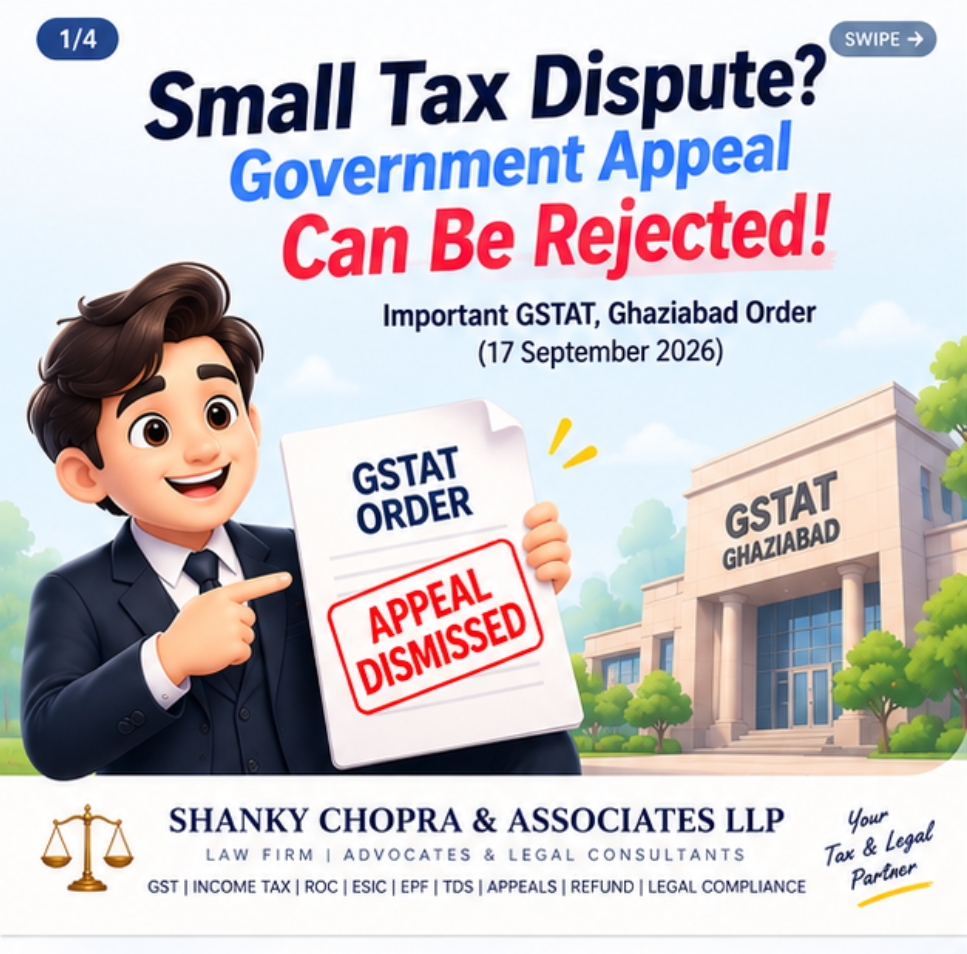
# GSTAT Ghaziabad Dismisses Departmental Appeal Below ₹20 Lakh Monetary Limit: Important GST Ruling 2026
## Introduction
The Goods and Services Tax Appellate Tribunal (GSTAT), Ghaziabad, has delivered an important order concerning the maintainability of departmental appeals where the disputed tax amount is below the prescribed monetary limit. The order dated 17 September 2026 in **Arvind Kumar Pathak v. Munna Steel, Proprietor** deals with an appeal filed by the Revenue against an order of the First Appellate Authority that had granted relief to the assessee.
The central issue before the Tribunal was not whether the underlying Input Tax Credit (ITC) dispute was legally correct on merits. Instead, the primary question was whether the departmental appeal itself could be admitted when the disputed tax amount was substantially below the prescribed monetary threshold for departmental litigation.
In the case, the disputed amount of IGST was **₹1,89,000**, whereas the applicable monetary limit for departmental appeals before GSTAT was **₹20 lakh**. The Department did not establish that the matter fell within any recognised exception to the monetary limit. Consequently, the Tribunal dismissed the departmental appeal at the threshold without examining the merits of the underlying ITC dispute.
This ruling is particularly relevant for taxpayers, GST practitioners, tax consultants and businesses dealing with GST appeals, ITC disputes, departmental litigation and GSTAT proceedings.
---
## Background of the GSTAT Case
The dispute related to the alleged excess availment and utilisation of Input Tax Credit for the period December 2020. Proceedings had been initiated under Section 74 of the UPGST Act, 2017.
The Proper Officer had raised a demand comprising:
* IGST of ₹1,89,000
* Interest of ₹50,082
* Penalty of ₹1,89,000
The aggregate amount was ₹4,28,082.
The assessee challenged the adjudication order before the First Appellate Authority. The First Appellate Authority allowed the appeal and set aside the order passed by the Proper Officer. It was also directed that any excess amount deposited under the relevant head should be refunded or adjusted in accordance with law.
Thereafter, the Revenue approached GSTAT challenging the relief granted by the First Appellate Authority.
At the admission stage, the Tribunal considered whether the Department's appeal satisfied the conditions necessary for being heard on merits.
---
## What Was the Main Issue Before GSTAT?
The most important question was whether a departmental appeal involving disputed tax of only ₹1.89 lakh could be entertained when the prescribed monetary limit for departmental appeals before GSTAT was ₹20 lakh.
The Tribunal emphasised that there is a fundamental difference between **filing an appeal** and **maintainability of an appeal**.
Simply because an appeal has been filed does not automatically mean that the Tribunal is required to hear the matter on merits. The right of appeal is a statutory right and must be exercised within the framework and conditions prescribed by law.
This distinction is important because departmental litigation is subject not only to the existence of an appellate remedy but also to the applicable litigation-control mechanism, including prescribed monetary limits.
---
## ₹20 Lakh Monetary Limit for Departmental Appeals
The Tribunal referred to Section 120 of the UPGST Act, 2017, which deals with cases where appeals are not to be filed and empowers the competent authority to prescribe monetary limits for departmental litigation.
The order refers to Circular No. 2425008 dated 5 July 2024, under which a monetary limit of ₹20 lakh was prescribed for departmental appeals before GSTAT, subject to specified exclusions and exceptions.
The Tribunal also referred to Circular No. 252/2026-27/State Tax dated 22 May 2026, which continued the framework concerning monetary limits, review mechanisms and departmental litigation before GSTAT and higher constitutional courts.
Therefore, according to the Tribunal, the monetary-limit policy continued to form part of the Department's litigation-management framework.
---
## How Is the Monetary Limit Calculated?
One of the most useful aspects of the order is the discussion regarding the methodology for calculating the monetary threshold.
The Tribunal referred to the departmental methodology under which, where the dispute relates to a demand of tax with or without interest and/or penalty, the **amount of tax in dispute** is considered for applying the monetary limit.
Where the dispute is only about interest, the interest amount is considered. Similarly, where the dispute relates only to penalty, the penalty amount is considered.
Therefore, in a case involving a disputed tax demand, the tax component is critical for determining whether the departmental appeal falls within the monetary threshold.
In the present case, the disputed IGST was ₹1,89,000.
The Tribunal therefore found:
**Disputed tax = ₹1,89,000**
**Prescribed monetary limit = ₹20,00,000**
Since ₹1.89 lakh was substantially below ₹20 lakh, the monetary restriction was attracted.
---
## Does a Case Below ₹20 Lakh Always Get Dismissed?
Not necessarily.
The Tribunal made it clear that the monetary limit is subject to recognised exceptions.
A departmental appeal below the prescribed threshold can still be considered where the Department establishes that the case falls within an applicable exception.
The order identifies several categories of exceptions, including matters involving constitutional validity, validity of rules, validity of notifications or circulars, valuation, classification, refund, place of supply, recurring issues involving interpretation of GST law, adverse comments or costs against the Department, and certain matters which the Commissioner considers necessary to contest in the interest of justice or revenue.
Therefore, the correct legal approach is not simply:
**"Below ₹20 lakh = appeal automatically impossible."**
Rather, the position is:
**"Below ₹20 lakh = monetary restriction applies unless the Department establishes a recognised exception."**
This distinction is very important for GST practitioners handling departmental appeals before GSTAT.
---
## Burden on the Department to Establish the Exception
The Tribunal placed the burden of establishing an exception on the Revenue.
Once it was demonstrated that the disputed amount was below ₹20 lakh, the Department had to disclose:
1. Which specific exception was being invoked;
2. What facts brought the case within that exception;
3. What statutory or administrative provision supported the exception; and
4. If the Commissioner’s residual discretion was relied upon, what order or recorded opinion demonstrated that the discretion had actually been exercised in the particular case.
This means that the Department cannot simply rely on a general statement that the appeal has been filed with the approval of the Commissioner.
The exception has to be properly established.
---
## Is Commissioner Approval Alone Sufficient?
The answer given by the Tribunal was **No**.
This is arguably one of the most significant observations in the order.
The Tribunal distinguished between:
**Administrative authorisation to file an appeal**
and
**Compliance with the statutory and administrative conditions governing maintainability.**
According to the Tribunal, these are two different matters.
If the Department relies upon the residual exception based on the Commissioner's opinion that a particular matter needs to be contested in the interest of justice or revenue, the record should demonstrate that the Commissioner actually formed such an opinion in relation to the particular case.
The basis for that opinion should also be discernible.
A generic or routine approval cannot automatically be converted into a statutory exception to the monetary limit.
This observation can be particularly relevant in cases where the Department's appeal papers contain only a general authorisation without explaining why the particular case deserves to be litigated despite the monetary threshold.
---
## Importance of Section 112(3) of the UPGST Act
The Tribunal also discussed Section 112(3) of the UPGST Act.
This provision permits the Commissioner, on his own motion or upon a request from the Commissioner of Central Tax, to call for and examine the record of an order passed by an Appellate Authority or Revisional Authority.
Where appropriate, the Commissioner may direct a subordinate officer to apply before the Appellate Tribunal within the prescribed period for determination of specified issues.
The Tribunal observed that a specific course of action is required before such permission is relied upon. The Tribunal should be able to examine how the opinion was formed and on what basis.
Therefore, a bare assertion that Commissioner permission was obtained was considered insufficient.
---
## GSTAT Must Examine Maintainability Before Merits
Another important principle emerging from the order is the sequence in which a departmental appeal should be examined.
The Tribunal stated that:
**Maintainability comes first; merits come afterwards.**
The Department had sought admission and consideration of the substantive ITC dispute. However, the Tribunal declined to proceed to the merits because the preliminary monetary-limit issue had not been satisfied.
The Tribunal explained that the merits of an appeal cannot themselves create maintainability if the conditions precedent for admission have not been fulfilled.
Similarly, the existence of an arguable issue on merits does not automatically override a binding monetary-limit policy.
This principle can be particularly important during the admission stage of GSTAT proceedings.
---
## Did the Tribunal Decide Whether the ITC Was Correct or Wrong?
No.
This point should be clearly understood.
The Tribunal did **not** decide that the assessee was necessarily entitled to the disputed ITC on merits.
It also did not decide that the Proper Officer's original ITC demand was legally incorrect on merits.
The appeal was dismissed because of the monetary-limit and maintainability issue.
The Tribunal expressly stated that it had not examined or adjudicated the merits of the underlying tax dispute.
Therefore, the order should primarily be understood as a ruling concerning **departmental appeal maintainability and litigation policy**, rather than a final judgment on the substantive ITC dispute.
---
## Importance for GST Taxpayers
This order may be relevant to taxpayers who have received favourable orders from First Appellate Authorities and subsequently face departmental appeals before GSTAT.
Where the disputed tax amount is below the prescribed departmental monetary threshold, the taxpayer may examine:
* The actual disputed tax amount;
* The applicable monetary-limit circular;
* Whether the Department has specifically pleaded an exception;
* Whether the facts genuinely fall within that exception;
* Whether the Commissioner has recorded a specific and reasoned opinion where required;
* Whether the Department has relied merely on a general approval; and
* Whether the appeal should be rejected at the admission stage on maintainability grounds.
These issues may form part of a taxpayer's preliminary objection, depending on the facts and applicable litigation policy.
---
## Relevance for GST Appeals in Moradabad, Kanth and Delhi
Businesses and taxpayers in **Moradabad, Kanth and surrounding areas** regularly face GST notices, ITC disputes, assessment proceedings, refund matters and departmental appeals.
Similarly, businesses operating in Delhi and other parts of Uttar Pradesh may encounter litigation before GST appellate forums.
For taxpayers and GST professionals, the present GSTAT Ghaziabad order demonstrates why the preliminary scrutiny of a departmental appeal is important.
Before entering into detailed arguments on ITC, classification, valuation, demand or penalty, the taxpayer may need to examine whether the Department's appeal itself satisfies the applicable statutory and administrative conditions.
This does not mean that every departmental appeal below ₹20 lakh will automatically fail. The existence of recognised exceptions must always be examined on the facts and under the applicable circular or litigation policy.
---
## Important Supreme Court Authorities Referred to in the Order
The GSTAT order refers to several judicial authorities while discussing the statutory nature of the right of appeal and the importance of litigation-control mechanisms.
The Tribunal referred to **Ganga Bai v. Vijay Kumar**, where the distinction between a right to sue and a right of appeal was discussed.
The order also refers to **Anant Mills Co. Ltd. v. State of Gujarat**, concerning the statutory nature of the right of appeal and conditions regulating its exercise.
The Tribunal further referred to **Ranadey Micronutrients v. Collector of Central Excise** in the context of the binding nature and importance of departmental circulars.
The order also discusses **Director of Income Tax v. S.R.M.B. Dairy Farming (P) Ltd.** concerning governmental litigation and the need to control unnecessary multi-level litigation.
These authorities were used in the order to support the broader principle that statutory appellate rights remain subject to the framework and conditions governing their exercise.
---
## Responsible Government Litigation
The Tribunal also discussed the wider public-policy rationale behind monetary limits.
Government litigation consumes judicial time, departmental resources, public money and the time of officers and taxpayers.
A monetary threshold is therefore intended to help the Department focus litigation resources on cases involving significant revenue, important legal questions, recurring issues or recognised exceptions.
The Tribunal observed that a ₹20 lakh threshold does not mean that a lower-value demand is legally insignificant. Rather, it reflects a policy decision concerning litigation discipline, allocation of public resources and prioritisation of disputes.
This approach is relevant to the broader objective of reducing unnecessary litigation and ensuring that important legal questions receive appropriate judicial attention.
---
## Final Decision of GSTAT Ghaziabad
After considering the entire material, the Tribunal recorded five principal findings.
First, the appeal was a departmental appeal and was therefore governed by the monetary-limit framework.
Second, the disputed amount relevant for applying the threshold was IGST of ₹1,89,000, which was below ₹20 lakh.
Third, the Revenue failed to establish that the appeal fell within a recognised exception.
Fourth, no material was produced demonstrating a specific and reasoned exercise of the Commissioner's residual power sufficient to bring the appeal within an exception.
Fifth, the appeal could not therefore be admitted for adjudication on merits.
The final order consequently dismissed the departmental appeal at the threshold on the ground of the prescribed monetary limit and non-establishment of an applicable exception.
The Tribunal specifically clarified that the merits of the tax dispute had not been examined.
---
## Key Takeaways for GST Practitioners
The GSTAT Ghaziabad order provides several practical points for consideration:
**1. Monetary limit is an important preliminary issue.**
Before entering into the merits of a departmental appeal, the applicable monetary threshold should be examined.
**2. Tax amount matters where tax demand is disputed.**
The methodology referred to in the order focuses on the disputed tax amount for a tax-demand dispute.
**3. Exceptions must be established.**
The Department cannot merely state that an exception exists.
**4. Commissioner approval is not automatically sufficient.**
A general authorisation should not be treated as equivalent to a reasoned exercise of the statutory discretion contemplated by the applicable framework.
**5. Maintainability comes before merits.**
A Tribunal may dismiss an appeal at the threshold without examining the substantive tax dispute.
**6. Every case must be examined independently.**
The applicability of an exception depends upon the facts and the relevant statutory and administrative framework.
---
## Conclusion
The GSTAT Ghaziabad order dated 17 September 2026 in **Arvind Kumar Pathak v. Munna Steel, Proprietor** provides an important discussion on departmental GST appeals below the prescribed monetary limit.
The disputed IGST in the matter was ₹1.89 lakh, substantially below the ₹20 lakh threshold referred to by the Tribunal. Since the Revenue failed to establish any applicable exception and did not demonstrate a specific and reasoned exercise of the Commissioner's residual power, the departmental appeal was dismissed at the threshold.
The order also reinforces an important procedural principle: **filing an appeal and establishing its maintainability are not the same thing.** A statutory right of appeal must be exercised within the framework and conditions prescribed by law and applicable departmental litigation policy.
For taxpayers, GST practitioners, tax consultants and businesses in Moradabad, Kanth, Delhi and across India, the decision highlights the importance of examining the preliminary maintainability of departmental GST appeals before proceeding into lengthy arguments on the merits.
At the same time, the ruling should not be interpreted as a decision on the correctness of the disputed ITC. The Tribunal expressly confined its decision to maintainability based on the monetary-limit regime and did not adjudicate the underlying tax dispute on merits.
Accordingly, whenever a departmental GST appeal is received, taxpayers should carefully examine the disputed tax amount, the applicable monetary-limit instructions, possible exceptions and the documents relied upon by the Department. A properly structured preliminary objection may be relevant where the statutory and administrative conditions for departmental litigation have not been satisfied.
Have Questions? We're Here to Help
Get expert advice from SHANKY CHOPRA & ASSOCIATES LLP. Reach out to discuss your requirements.