
GSTAT SOP for Filing Reply by Respondents | GSTAT Reply Procedure
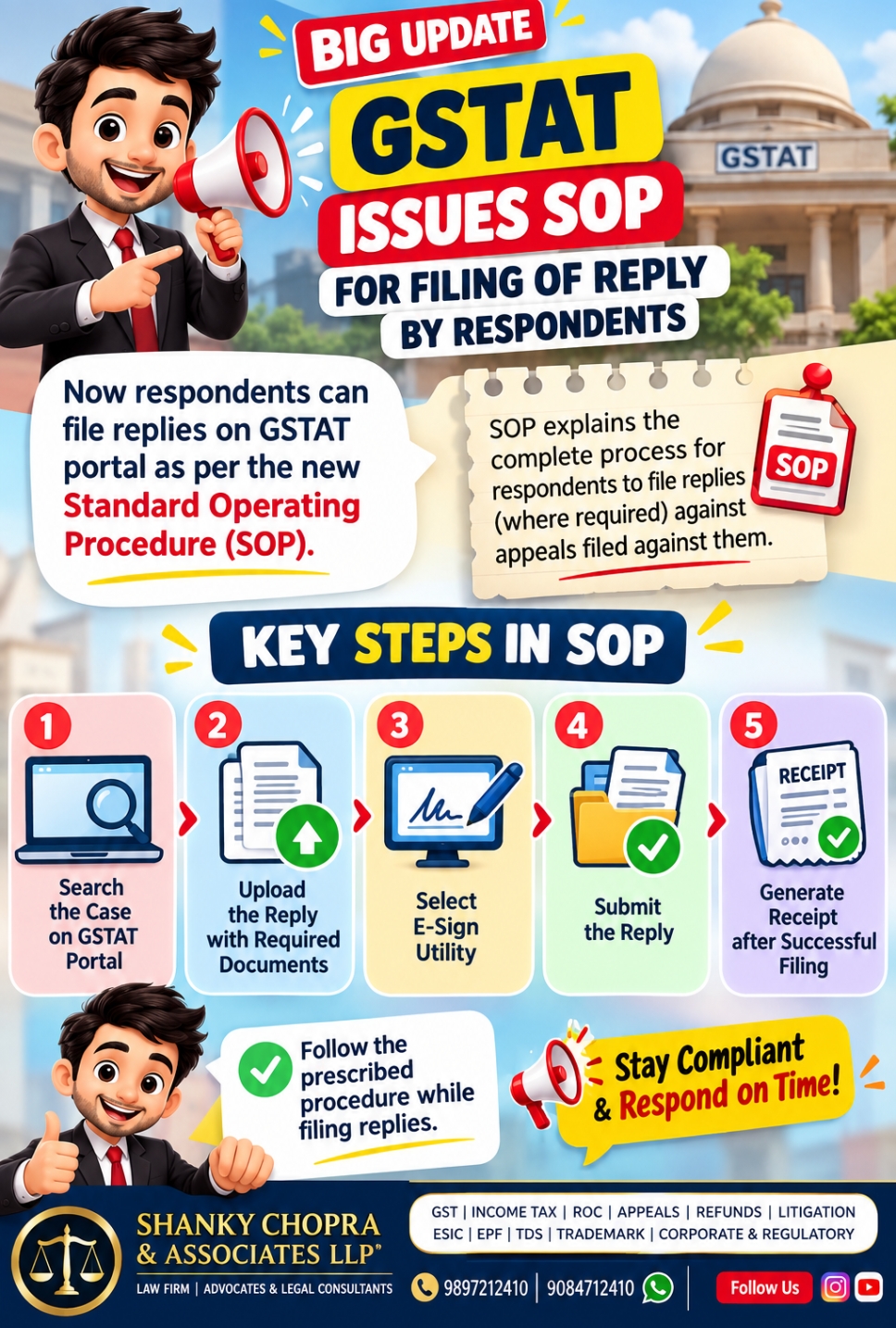
# GSTAT Issues New SOP for Filing Reply by Respondents: Complete Guide to GSTAT Reply Filing Procedure
The Goods and Services Tax Appellate Tribunal (GSTAT) has introduced a **Standard Operating Procedure (SOP) for filing replies by respondents** through the GSTAT e-Filing Portal. The new facility provides a structured electronic process for respondents who are required to place their reply and supporting documents on record in GSTAT proceedings.
The SOP is particularly important for **GST taxpayers, GST practitioners, taxation advocates, departmental officers and authorised representatives** appearing before GSTAT. The official GSTAT e-Filing portal now lists **“SOP-Reply Filing”** among its Presidential Orders/Advisories and procedural resources.
For professionals handling GST litigation in **Moradabad, Kanth, Delhi, Uttar Pradesh and other parts of India**, understanding the distinction between a respondent's reply and a statutory cross-objection is especially important.
## What is the GSTAT Reply Filing SOP?
The GSTAT Reply Filing SOP explains the electronic procedure through which a **respondent can file a reply against an appeal or proceeding filed before the Tribunal**.
The SOP essentially converts the procedural right contained in **Rule 36 of the GSTAT (Procedure) Rules, 2025** into an online filing workflow. The GSTAT Procedure Rules, 2025 were notified through the Central Government's notification dated 24 April 2025. ([efiling.gstat.gov.in][1])
Under Rule 36, a respondent may file a reply to the petition or application along with copies of relevant documents, either personally or through an authorised representative, with the Registrar in the manner specified by the Tribunal. The rule generally provides a period of **one month from receipt of the proceeding**, subject to the applicable procedural position and any time specified or extended by the Tribunal. ([efiling.gstat.gov.in][1])
The respondent is also required to serve a copy of the reply and supporting documents on the applicant.
---
# Who is the Respondent in GSTAT Proceedings?
One of the most important points for taxpayers is that **“Respondent” does not necessarily mean the GST officer.**
The identity of the respondent depends upon **who has filed the appeal**.
### When the taxpayer files the appeal
If a taxpayer or registered person files an appeal before GSTAT against a GST appellate order, the concerned **department/Commissioner is generally the respondent**.
For example:
**Appellant:** Taxpayer
**Respondent:** GST Department/Commissioner
In such a case, the departmental side may file its reply through the authorised departmental representative.
### When the Department files the appeal
If the GST Department files an appeal against an order in favour of the taxpayer, the taxpayer may become the **respondent**.
For example:
**Appellant:** GST Department
**Respondent:** Taxpayer
In this situation, the taxpayer can file the reply before GSTAT through the taxpayer personally or through an **authorised representative**, such as an advocate or other permitted representative.
The GSTAT Procedure Rules specifically recognise the role of respondents and the filing of replies through an authorised representative. ([efiling.gstat.gov.in][1])
---
# Legal Basis of GSTAT Reply Filing
The principal procedural provision for the respondent's reply is **Rule 36 of the GSTAT (Procedure) Rules, 2025**.
Rule 36 deals with:
* Filing of reply by the respondent
* Filing of supporting documents
* Filing personally or through an authorised representative
* Time period for filing
* Service of the reply on the applicant
The rules further provide for the applicant's response to facts stated by the respondent and the possibility of a rejoinder in appropriate circumstances. ([Lawspedia][2])
This makes it important for a respondent not to treat the GSTAT reply as a simple covering letter. A proper reply should respond meaningfully to the grounds raised by the appellant and place relevant facts and documents before the Tribunal.
---
# GSTAT Reply and Cross-Objection Are Not the Same
This distinction is extremely important.
A **Reply** and a **Cross-Objection** serve different procedural purposes.
A reply is generally used by the respondent to **answer the case, grounds, facts and contentions raised by the appellant**.
A cross-objection, on the other hand, is a separate statutory mechanism where the respondent seeks to challenge an adverse part of the order or seeks relief of its own, subject to the applicable provisions.
The GSTAT portal's new reply-filing facility therefore does not mean that every respondent has to file a cross-objection.
The respondent should first determine:
**“Do I only need to defend/respond to the appeal?”**
or
**“Do I also need to independently challenge an adverse portion of the order?”**
The answer can affect whether a simple reply is sufficient or whether a separate cross-objection should also be considered.
This distinction has practical significance for taxpayers in **Moradabad, Kanth, Delhi and other jurisdictions** because filing a reply should not inadvertently be treated as a substitute for a statutory cross-objection where independent relief is required.
---
# How to File GSTAT Reply Online?
The new SOP provides an electronic workflow on the GSTAT portal.
The broad process is as follows.
## Step 1 – Login to GSTAT Portal
The respondent or authorised representative first needs to access the GSTAT e-Filing Portal and log in using the applicable credentials.
The GSTAT portal provides electronic filing facilities for Tribunal proceedings and related documents.
The official GSTAT e-Filing portal currently lists the **SOP-Reply Filing** facility among its procedural resources.
## Step 2 – Go to Respondent Corner
After login, the user needs to access the **Respondent Corner**.
The relevant option for filing the response is:
**Respondent Corner → File Reply**
This is the dedicated workflow for submitting the respondent's reply electronically. ([taxscan.in][3])
## Step 3 – Search the Case
The SOP provides an option to search the relevant proceeding by case details.
The reported workflow includes:
* Security Code
* Case Type
* Case Number
* Location
* Case Year
After entering the relevant information, the user can search for the case. ([taxscan.in][3])
The respondent should carefully verify the case details before uploading documents.
---
# Step 4 – Select the Relevant Case
Once the case is located, the relevant proceeding should be selected for filing the reply.
The respondent's details are displayed in the filing interface, and the user can proceed with document uploading.
It is advisable to verify:
* Case number
* Appellant name
* Respondent name
* Bench/location
* Case year
* Type of proceeding
before making the final submission.
This is particularly important because GSTAT litigation may involve several connected proceedings or appeals arising from the same assessment, adjudication or appellate order.
---
# Step 5 – Upload the Reply
The respondent then needs to upload the **Reply** document.
The reply should preferably be properly drafted and arranged with:
1. Case title
2. Appeal/application number
3. Details of appellant and respondent
4. Preliminary submissions, where applicable
5. Reply to grounds of appeal
6. Factual submissions
7. Legal submissions
8. Supporting documents
9. Prayer
10. Verification/signature, as applicable
The supporting documents should be properly indexed and referenced in the reply.
A well-prepared GSTAT reply can make the Tribunal's task easier by clearly connecting each document with the relevant factual or legal submission.
---
# Step 6 – Supporting Documents
The respondent may need to upload documents supporting the reply.
Depending upon the nature of the case, documents can include:
* GST registration details
* Orders passed by adjudicating authority
* First appellate authority order
* Show cause notice
* DRC-01/DRC-07 and related documents
* GSTR-1
* GSTR-3B
* GSTR-2B
* E-way bills
* Tax invoices
* Credit/debit notes
* Reconciliation statements
* Audit reports
* Correspondence with the department
* Relevant judgments
* Other evidence relied upon in the appeal
The documents should be relevant to the grounds being answered rather than unnecessarily uploading a large quantity of unrelated material.
---
# Step 7 – Select E-Sign Facility
The GSTAT Reply Filing SOP provides electronic signing options for submission.
The reported portal workflow provides options including:
* **External DSC Utility**
* **NIC DSC Utility**
* **Aadhaar Based Utility**
The appropriate available option can be selected before submitting the document. ([taxscan.in][3])
The exact portal interface may be updated by GSTAT from time to time, so users should follow the current instructions displayed on the official portal.
---
# Step 8 – Verify the Uploaded Documents
Before final submission, the respondent should carefully check:
* Whether the correct reply has been uploaded
* Whether all annexures are attached
* Whether the documents are readable
* Whether the correct case has been selected
* Whether the respondent name is correct
* Whether the document type is selected correctly
The reported SOP workflow also provides an opportunity to view uploaded documents and, where applicable, delete and replace them before final submission. ([taxscan.in][3])
This verification stage is important because an incorrect document can create unnecessary procedural complications.
---
# Step 9 – Submit the Reply
After verification, the respondent can proceed with final submission.
The portal displays a confirmation after successful submission.
The respondent should preserve the filing acknowledgement/receipt for the case record.
The SOP workflow provides an option to **Print Receipt** after successful filing. ([taxscan.in][3])
The receipt should ideally be saved with the complete case file.
---
# One-Month Period for Respondent's Reply
Rule 36 is particularly important regarding the timeline.
The rule provides that the respondent may file the reply and documents **within one month of receipt** of the relevant petition/application, subject to the applicable procedural provisions. ([Lawspedia][2])
Therefore, a respondent should not wait until the date of hearing to consider filing the reply.
A practical GST litigation file should record:
**Date of receipt/service → Last date → Drafting → Document compilation → Review → E-sign → GSTAT filing → Service/record of service**
The actual limitation or extension position should always be checked against the latest applicable rules, Tribunal directions and case-specific orders.
---
# Service of Reply on the Appellant
Another important aspect is that filing the reply on the GSTAT portal should not be viewed in isolation.
Rule 36 also provides that a copy of the reply and copies of other documents are to be served on the applicant by the respondent. ([Lawspedia][2])
Therefore, the case file should maintain proof of service wherever required.
For professional GST litigation practice, maintaining a complete electronic file containing:
* Filed reply
* Annexures
* Filing receipt
* Proof of service
* Correspondence
* Authority/appearance documents
can be very useful at the subsequent hearing stage.
---
# Why the New GSTAT SOP Is Important for Taxpayers
The introduction of a dedicated online reply facility is significant because GSTAT proceedings are increasingly moving toward a structured electronic filing system.
For taxpayers, it provides a clearer mechanism to place their defence before the Tribunal.
For GST professionals, it creates a more defined workflow for managing respondent-side litigation.
For the Department, it provides a dedicated electronic route for submitting departmental replies.
The official GSTAT portal itself lists separate procedural resources, including the **Reply Filing SOP** and the **Transfer Application SOP**.
---
# Importance for GST Litigation in Moradabad and Kanth
Taxpayers and businesses in **Moradabad and Kanth** may face GST disputes involving:
* GST demand
* Input Tax Credit
* Classification disputes
* E-way bill issues
* GST registration cancellation
* Refund disputes
* Interest
* Penalty
* Section 73 proceedings
* Section 74 proceedings
* Assessment orders
* Audit disputes
* First appellate orders
* Other GST litigation
When such a matter reaches GSTAT, understanding the respondent's filing procedure becomes important.
A taxpayer from **Moradabad, Kanth, Bilari, Kundarki, Thakurdwara or surrounding areas** may need professional assistance in understanding whether the matter requires a reply, cross-objection, additional application or supporting evidence.
A properly structured reply can help ensure that the taxpayer's factual and legal position is placed on record before the Tribunal.
---
# GSTAT Reply Assistance in Delhi
Delhi is also an important centre for GST litigation and professional representation because the GSTAT system operates through its Principal Bench and various benches.
Businesses having operations in **Delhi, Noida, Ghaziabad, Uttar Pradesh and other parts of India** may require assistance with GSTAT appeals and respondent-side proceedings.
Professional assistance may include:
* GSTAT appeal drafting
* GSTAT reply drafting
* Grounds of appeal
* Legal submissions
* Compilation of documents
* Case law research
* Cross-objection analysis
* Authorisation and appearance
* GST litigation strategy
* Hearing preparation
Businesses should ensure that the correct procedural route is selected before filing.
---
# Role of a Taxation Advocate in GSTAT Proceedings
GSTAT litigation often involves more than simply uploading a document.
A professional handling a GSTAT matter may need to examine:
* The original adjudication order
* Appellate order
* Grounds raised in appeal
* Evidence relied upon by the appellant
* Documents already available on the GST portal
* Applicable provisions of the CGST/SGST Act
* GST Rules
* Notifications and circulars
* Judicial precedents
* Factual inconsistencies
* Demand computation
* Interest and penalty issues
The reply should then be drafted around the actual grounds raised in the appeal.
A generic reply may not adequately address a complicated GST dispute.
---
# GSTAT Reply Filing – Practical Checklist
Before filing a reply, the respondent can use the following checklist:
### Case Details
☐ Correct GSTAT case number
☐ Correct case year
☐ Correct appellant
☐ Correct respondent
☐ Correct bench/location
### Reply
☐ Reply properly drafted
☐ Preliminary objections considered
☐ Each ground answered
☐ Facts verified
☐ Legal provisions checked
☐ Prayer included
### Documents
☐ Index prepared
☐ Annexures numbered
☐ Relevant orders attached
☐ Supporting evidence attached
☐ Documents readable
### Filing
☐ Correct document type selected
☐ Appropriate e-sign method selected
☐ Final document verified
☐ Submission completed
☐ Filing receipt downloaded
☐ Copy served on applicant where required
---
# GSTAT Reply Filing vs Cross-Objection
The distinction can be summarised simply:
| Reply | Cross-Objection |
| ------------------------------------------------------- | ------------------------------------------------------------- |
| Responds to the appellant's case | Can be used to challenge an adverse part of the order |
| Governed procedurally by Rule 36 | Separate statutory/procedural mechanism |
| Used for defence/response | Used where independent relief/challenge is required |
| Filed through respondent filing mechanism | Separate cross-objection procedure |
| Does not automatically substitute for a cross-objection | Should be considered where independent challenge is necessary |
Therefore, taxpayers should not automatically assume that filing a **Reply** protects every possible right against an adverse part of the underlying order.
The appropriate remedy should be examined based on the facts and the relief sought.
---
# Conclusion
The new **GSTAT SOP for Reply Filing by Respondents** is an important procedural development for GST litigation. It provides respondents with a dedicated electronic mechanism to search their cases, upload replies and supporting documents, complete electronic signing and obtain a filing receipt.
The statutory foundation for the respondent's reply is **Rule 36 of the GSTAT (Procedure) Rules, 2025**, while the new SOP provides the practical online filing workflow.
For taxpayers and GST professionals in **Moradabad, Kanth and Delhi**, the development is particularly relevant as GSTAT proceedings become increasingly digital.
However, respondents should carefully distinguish between a **reply under Rule 36** and a **cross-objection**, particularly where the respondent wishes to obtain independent relief against an adverse portion of the order.
Before filing, it is advisable to verify the latest GSTAT portal instructions, applicable rules, case-specific directions and filing timelines. The official GSTAT website provides access to the GSTAT Procedure Rules, orders, notices, cause lists, case status and other Tribunal resources. ([Government Statistics][4])
**Shanky Chopra & Associates LLP** provides professional assistance in **GSTAT appeals, GST replies, GST litigation, GST notices, appeals, refunds, taxation matters and legal compliance** for clients in **Moradabad, Kanth, Delhi and other locations**, subject to the facts and requirements of each case.
**GSTAT Reply Filing, GSTAT SOP, GSTAT Respondent, GSTAT Appeal, GST Appeal Reply, GSTAT Procedure, GSTAT Litigation, GSTAT Advocate, GST Tax Litigation, GSTAT Reply in Moradabad, GST Advocate Moradabad, GST Consultant Moradabad, GSTAT Kanth, GST Litigation Kanth, GSTAT Delhi, GST Advocate Delhi, GST Appeal Delhi, GST Legal Services Moradabad, GSTAT Reply Filing Procedure, Rule 36
**GSTAT Reply Filing SOP 2026: Complete Procedure for Respondents | Moradabad, Kanth & Delhi**
**Learn the latest GSTAT Reply Filing SOP for respondents, Rule 36 procedure, online filing steps, documents, e-sign, timelines and reply vs cross-objection for GSTAT matters in Moradabad, Kanth and Delhi.**
Have Questions? We're Here to Help
Get expert advice from SHANKY CHOPRA & ASSOCIATES LLP. Reach out to discuss your requirements.