
AOC-4 Filing Due Date for OPC – FY 2025-26 | 27 September 2026
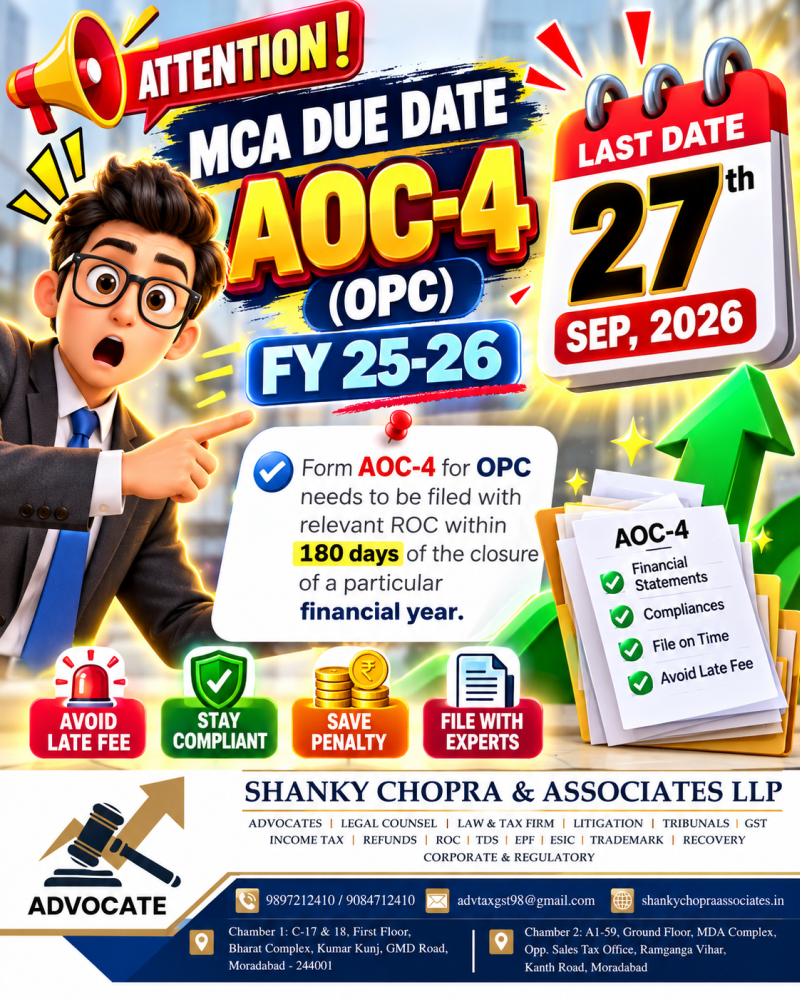
AOC-4 Due Date for OPC for FY 2025-26: Complete Guide to Annual ROC Compliance
One Person Company (OPC) is a popular business structure for entrepreneurs who want to operate through a corporate entity while retaining single-member ownership. Although an OPC has certain relaxations compared with other companies, it is still required to comply with important provisions of the Companies Act, 2013 and applicable MCA filing requirements.
One of the most important annual ROC compliances for an OPC is the filing of Form AOC-4, through which the company's financial statements are filed with the Registrar of Companies (ROC).
For Financial Year 2025-26, the normal statutory due date for filing AOC-4 by an OPC is 27 September 2026.
The reason is that the financial year ended on 31 March 2026, and Section 137 of the Companies Act, 2013 specifically provides a period of 180 days from the closure of the financial year for an OPC to file its duly adopted financial statements with the Registrar. (Indian Kanoon)
AOC-4 Due Date for OPC – FY 2025-26
The important details are:
| Particular | Details |
|---|---|
| Company Type | One Person Company (OPC) |
| Financial Year | FY 2025-26 |
| Financial Year End | 31 March 2026 |
| Form | AOC-4 |
| Applicable Law | Section 137, Companies Act, 2013 |
| Filing Period | Within 180 days from closure of FY |
| Due Date | 27 September 2026 |
| Filing Authority | Registrar of Companies / MCA |
Thus, OPCs having financial year ending 31 March 2026 should ensure that their AOC-4 filing is completed within the prescribed period.
The MCA's prescribed AOC-4 is the form for filing financial statements and related documents with the Registrar under Section 137 and Rule 12 of the Companies (Accounts) Rules, 2014. (Ministry of Corporate Affairs)
What is Form AOC-4?
Form AOC-4 is an electronic form used for filing a company's financial statements and applicable documents with the Registrar of Companies.
The filing provides the ROC with important information about the financial position and affairs of the company for the relevant financial year.
Depending upon the nature and applicability of the company, the financial statement filing may involve documents such as:
-
Balance Sheet
-
Statement of Profit and Loss
-
Notes to Accounts
-
Auditor's Report
-
Board's Report
-
Applicable disclosures
-
Related-party disclosures, wherever applicable
-
Other documents required under the Companies Act
-
Applicable financial statement-related attachments
The exact attachments depend upon the company's circumstances and the requirements applicable to that particular OPC.
The MCA-prescribed AOC-4 specifically captures details relating to the financial year and the date on which the financial statements were approved, among other information. (Ministry of Corporate Affairs)
Why is 27 September 2026 Important for OPCs?
For most companies, financial statement filing is connected with the date of the Annual General Meeting. However, an OPC receives a specific statutory treatment.
Section 137 provides that an OPC is required to file a copy of its financial statements, duly adopted by its member, along with the documents required to be attached to those financial statements, within 180 days from the closure of the financial year. (Indian Kanoon)
For FY 2025-26:
31 March 2026 + 180 days = 27 September 2026
Therefore, 27 September 2026 is the statutory due date for the AOC-4 filing of an OPC for FY 2025-26.
This is particularly important for OPC owners and professionals handling ROC compliance because missing the prescribed date can result in additional filing consequences.
Is AGM Required for an OPC?
One important distinction between an OPC and many other companies is that an OPC is not required to conduct an Annual General Meeting in the same manner as an ordinary company.
The Companies Act provides specific exemptions and modifications for OPCs. This is one reason why the AOC-4 timeline for an OPC is directly linked to 180 days from the closure of the financial year, rather than the normal AGM-based filing timeline.
Therefore, an OPC should not assume that its AOC-4 due date will be calculated in the same way as an ordinary private limited company.
The financial statements still need to be properly prepared, approved/adopted and filed with the ROC within the applicable statutory period.
What Documents Should Be Prepared Before AOC-4 Filing?
Before filing AOC-4, the OPC should ensure that its annual financial and statutory records are complete.
Generally, the following documents and information should be reviewed:
1. Balance Sheet
The Balance Sheet should properly reflect the company's assets, liabilities, share capital, reserves and other applicable balances as on 31 March 2026.
2. Statement of Profit and Loss
The Statement of Profit and Loss should contain the company's income, expenses, profit or loss and other applicable financial information for FY 2025-26.
3. Notes to Accounts
The applicable notes and accounting disclosures should be prepared along with the financial statements.
4. Auditor's Report
Where statutory audit is applicable, the auditor's report should be available and properly considered while completing the ROC filing.
5. Board's Report
An OPC is required to comply with the provisions applicable to its Board's Report, subject to the specific provisions and exemptions applicable to OPCs.
The Companies (Accounts) Rules also prescribe specific matters for the Board's Report of OPCs and small companies. (Ministry of Corporate Affairs)
6. Approval and Adoption of Financial Statements
The financial statements should be appropriately approved and adopted in accordance with the applicable provisions before filing.
7. Director and Company Details
The company's CIN, registered office details, authorised capital, paid-up capital, director information and other relevant details should be checked before submission.
AOC-4 and MGT-7A – Do Not Confuse the Two
A common issue in annual ROC compliance is confusing AOC-4 with the annual return.
They are different forms and serve different purposes.
AOC-4
AOC-4 relates primarily to the filing of financial statements and related documents with the ROC.
MGT-7A
MGT-7A is the abridged annual return form applicable to OPCs and small companies. MCA introduced MGT-7A specifically as the abridged annual return form for OPCs and small companies. (Ministry of Corporate Affairs)
Therefore, filing AOC-4 does not mean that all annual ROC compliance of an OPC is completed.
The company should separately review its annual return and other applicable compliances.
What is the Due Date of MGT-7A for FY 2025-26?
For an OPC, the annual return is filed in MGT-7A, subject to applicability.
The due date calculation for annual return is different from the special 180-day financial statement filing provision applicable to an OPC.
Therefore, an OPC should maintain a separate compliance calendar for:
-
AOC-4
-
MGT-7A
-
Income Tax Return
-
DIR-3 KYC, where applicable
-
DPT-3, where applicable
-
MSME-1, where applicable
-
GST compliances, where applicable
-
Other event-based ROC filings
AOC-4 filing should therefore not be treated as the only annual compliance of the company.
Other Important OPC Annual Compliances
Apart from AOC-4, an OPC should review its entire compliance position for FY 2025-26.
1. MGT-7A
The OPC generally files its annual return through MGT-7A, the abridged annual return form prescribed for OPCs and small companies. (Ministry of Corporate Affairs)
2. Income Tax Return
The company is also required to comply with applicable Income Tax provisions and file its corporate Income Tax Return within the prescribed statutory timeline.
The Income Tax compliance is separate from MCA annual filing.
3. DIR-3 KYC
Where applicable, directors must ensure their DIN-related KYC compliance is completed within the prescribed timeline.
4. DPT-3
If applicable based on the company's transactions and outstanding amounts covered by the relevant provisions, DPT-3 compliance should be reviewed.
5. MSME-1
Where the company falls within the applicability of the MSME reporting requirements, the relevant half-yearly filing should be examined.
6. GST Compliance
If the OPC is registered under GST, its GST return, annual return and reconciliation requirements should be separately reviewed based on turnover, nature of business and applicability.
7. Statutory Audit
The company's books and financial statements should be reviewed for statutory audit requirements and completion of the auditor's report before the relevant annual filings.
What Happens If AOC-4 Is Filed Late?
Timely filing is important because the Companies Act provides additional filing consequences where financial statements are not filed within the prescribed period.
A delay in ROC filing can result in additional fees and other statutory consequences.
Therefore, an OPC should not wait until the last moment, particularly when the financial statements, audit, attachments, DSC or MCA portal filing requirements still need to be completed.
Late filing can also create practical problems in future compliance work, due diligence, banking requirements, loan applications, business transactions, investor discussions and other corporate documentation.
For this reason, maintaining a proper annual compliance calendar is advisable.
Important Checklist Before Filing AOC-4
Before submitting AOC-4 for FY 2025-26, an OPC can use the following checklist:
Financial Records
☑ Books of accounts completed
☑ Trial balance reviewed
☑ Balance Sheet prepared
☑ Profit & Loss Account prepared
☑ Notes to Accounts prepared
☑ Previous year's figures reconciled
☑ Bank balances checked
☑ Loans and liabilities verified
☑ Debtors and creditors reviewed
☑ Fixed assets and depreciation checked
Audit
☑ Auditor's financial statement review completed
☑ Auditor's Report available
☑ Qualifications, if any, examined
☑ Statutory audit requirements completed
Corporate Documents
☑ Board-related documentation checked
☑ Financial statements approved/adopted
☑ Board's Report prepared
☑ Applicable declarations and disclosures checked
☑ Director details verified
☑ Registered office details verified
MCA Filing
☑ Correct AOC-4 form selected
☑ CIN verified
☑ Financial year selected correctly
☑ Financial figures cross-checked
☑ Attachments prepared in prescribed format
☑ DSC checked
☑ Professional certification/signing requirements checked
☑ MCA V3 filing completed
☑ SRN/payment acknowledgement preserved
Why Should OPCs Avoid Last-Minute Filing?
Although MCA filings are electronic, several issues can arise during the filing process.
For example:
-
DSC may not work properly.
-
DSC may not be associated with the MCA profile.
-
Form validation may show errors.
-
Attachments may exceed permitted limits.
-
Financial figures may not match.
-
Previous ROC filings may contain discrepancies.
-
Company master data may require correction.
-
Professional certification requirements may need additional review.
-
MCA portal technical issues may delay submission.
Therefore, it is better to prepare the complete filing well before the due date rather than waiting until the last day.
For FY 2025-26, the key date for an OPC is:
🚨 AOC-4 – 27 SEPTEMBER 2026
Financial Year: 2025-26
Financial Year End: 31 March 2026
Filing Period: 180 days
Due Date: 27 September 2026
AOC-4 Filing for OPC in Moradabad and Kanth
OPCs operating from Moradabad, Kanth, Bilari, Kundarki, Thakurdwara, Pakbara and other areas of Uttar Pradesh should also ensure that their ROC records and statutory filings are maintained properly.
ROC compliance is not dependent merely on the size of the business. Even if an OPC has relatively low turnover or limited transactions, applicable statutory filings should be reviewed and completed.
A proper annual compliance review can also identify discrepancies between:
-
Books of accounts
-
GST returns
-
Income Tax records
-
Bank transactions
-
ROC financial statements
-
TDS records
-
Statutory audit records
Identifying such differences before filing can help reduce the possibility of future compliance issues.
Professional OPC Annual Compliance Services
Annual ROC compliance involves more than uploading a form.
A professional review may include:
✔ Preparation and review of financial statements
✔ AOC-4 filing
✔ MGT-7A filing
✔ Board's Report preparation
✔ ROC compliance review
✔ Director compliance review
✔ Income Tax compliance coordination
✔ GST compliance review
✔ MCA master data verification
✔ Statutory document maintenance
Businesses should ensure that their annual filings accurately represent the company's books and statutory records.
Conclusion
An One Person Company is required to maintain annual statutory compliance despite having only one member. One of the most important filings is Form AOC-4, through which the company's financial statements are submitted to the Registrar of Companies.
For FY 2025-26, an OPC whose financial year closed on 31 March 2026 has the statutory AOC-4 filing period of 180 days from the closure of the financial year, making 27 September 2026 the applicable due date. (Indian Kanoon)
OPC owners should therefore ensure that their accounts, audit, financial statements, Board's Report, applicable attachments and MCA filing requirements are completed in time.
AOC-4 is only one part of the annual compliance cycle. MGT-7A, Income Tax, director-related compliance, GST and other applicable statutory requirements should also be reviewed separately.
If you operate an OPC and have not yet completed your FY 2025-26 annual ROC compliance, it is advisable to arrange the documents and filing process without waiting for the deadline. 📑✅
Shanky Chopra & Associates LLP
Advocates | Legal Counsel | Law & Tax Firm | Litigation | Tribunals | GST | Income Tax | ROC | TDS | EPF | ESIC | Trademark | Corporate & Regulatory
📍 Moradabad & Kanth, Uttar Pradesh
📞 9897212410 / 9084712410
📧 advtaxgst98@gmail.com
🌐 shankychopraassociates.in
Professional Assistance for OPC, ROC & Corporate Compliance
This article is for general informational purposes. The applicability of individual compliance requirements should be checked based on the company's specific facts, financial statements and applicable provisions.
Have Questions? We're Here to Help
Get expert advice from SHANKY CHOPRA & ASSOCIATES LLP. Reach out to discuss your requirements.