
Can CGST Initiate Proceedings After State GST Action? Delhi High Court Explains
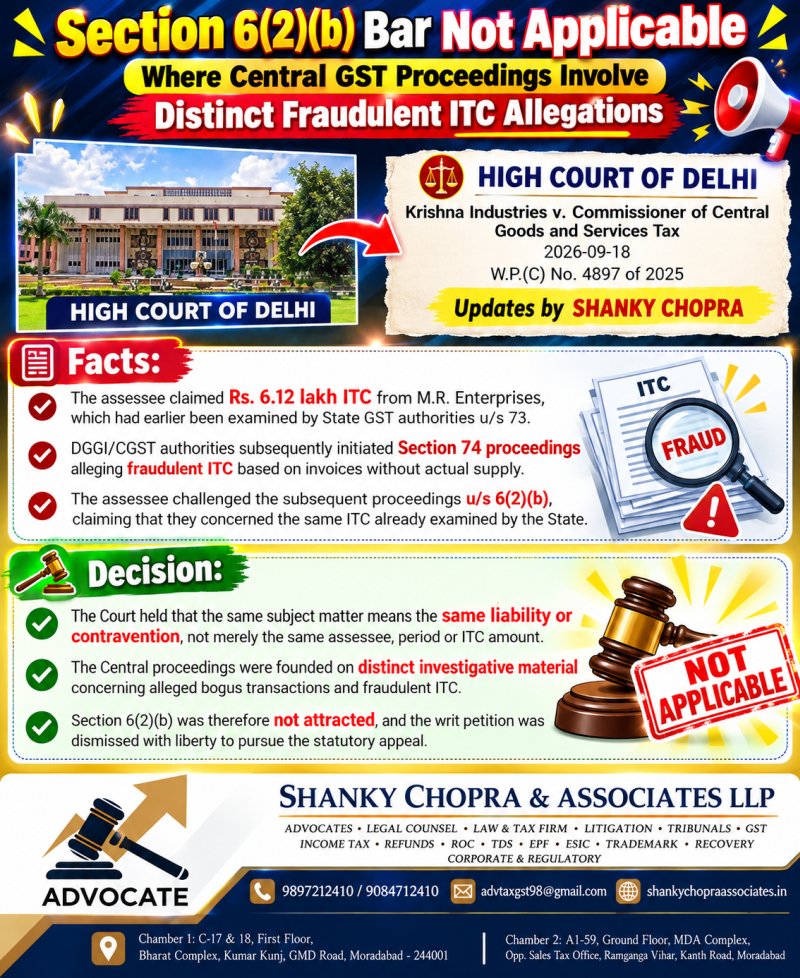
Delhi High Court Clarifies GST Section 6(2)(b): Meaning of “Same Subject Matter” in Parallel Proceedings
The Delhi High Court has recently examined an important question concerning Section 6(2)(b) of the Central Goods and Services Tax Act, 2017 (CGST Act)—whether Central GST authorities can initiate proceedings under Section 74 when State GST authorities have already undertaken proceedings under Section 73 concerning the same taxpayer and Input Tax Credit (ITC).
The judgment in Shri Krishna Industries through its Proprietor Prop. Mohan Lal v. Commissioner of Central Goods and Services Tax & Ors., W.P.(C) No. 4897/2025, was pronounced by the Delhi High Court on 18 September 2026. The Division Bench comprising Justice Anil Kshetarpal and Justice Shail Jain examined the scope of the expression “same subject matter” appearing in Section 6(2)(b). (Indian Kanoon)
The judgment is significant for taxpayers facing proceedings by both State and Central GST authorities, particularly where the proceedings concern ITC, alleged bogus transactions, invoices without actual supply, or allegations of fraud and suppression.
Understanding Section 6(2)(b) of the CGST Act
Section 6(2)(b) is intended to regulate overlapping jurisdiction between State and Central GST authorities.
In simple terms, where proceedings concerning the same subject matter have already been initiated by one tax authority, the other authority should not initiate another proceeding on that same subject matter.
The provision therefore becomes particularly relevant when a taxpayer receives proceedings from different GST authorities concerning the same period, transactions, supplier or ITC.
However, an important question arises:
What exactly constitutes the “same subject matter”?
Does the expression mean:
-
the same taxpayer?
-
the same financial year?
-
the same supplier?
-
the same ITC amount?
-
the same invoices?
-
or the same underlying tax liability and contravention?
The Delhi High Court's judgment provides important guidance on this issue. (Indian Kanoon)
Facts of the Shri Krishna Industries Case
The petitioner, Shri Krishna Industries, was a proprietorship concern of Shri Mohan Lal.
The dispute related to ITC allegedly availed from M.R. Enterprises.
For the relevant financial year, proceedings had earlier been initiated by the State GST authorities under Section 73 of the CGST Act.
The State proceedings concerned ITC claimed by the petitioner from M.R. Enterprises.
After an earlier round of proceedings, the State GST authority conducted fresh adjudication and passed an order dated 29 July 2024. (Indian Kanoon)
Subsequently, Central GST authorities initiated proceedings under Section 74.
Two Show Cause Notices were issued:
-
SCN dated 2 August 2024
-
SCN dated 4 August 2024
The Central proceedings were based upon investigation and intelligence material gathered by the Directorate General of Goods and Services Tax Intelligence (DGGI).
The Department alleged that invoices had been issued without corresponding actual supply of goods and that inadmissible ITC had been availed/passed on through such transactions. (Indian Kanoon)
The Petitioner's Main Argument
The taxpayer approached the Delhi High Court challenging the subsequent Central GST proceedings.
The principal argument was that the State GST authorities had already dealt with the ITC issue.
According to the petitioner:
-
the taxpayer was the same;
-
the financial year was the same;
-
the ITC involved was the same;
-
the supplier was M.R. Enterprises;
-
the State GST authorities had already initiated proceedings;
-
a fresh order had already been passed by the State authority.
Therefore, according to the petitioner, the subsequent Central GST proceedings amounted to proceedings concerning the same subject matter and were consequently barred by Section 6(2)(b). (Indian Kanoon)
The petitioner also relied upon the Supreme Court's decision in Armour Security (India) Ltd. v. Commissioner, CGST, Delhi East Commissionerate & Anr. and the Delhi High Court's decision in Metalax Industries v. GST Officer, Ward 66 & Ors. (Indian Kanoon)
Department's Stand
The Department disputed the contention that the two proceedings were identical.
The Central proceedings were based upon DGGI investigation and intelligence concerning alleged bogus transactions and fraudulent availment of ITC without actual supply of goods.
The Department therefore maintained that the Central proceedings involved a distinct alleged contravention and could not automatically be treated as identical merely because the taxpayer, period or ITC amount happened to overlap.
The judgment also records that the two Central proceedings referred to M.R. Enterprises with different GSTINs, which was another factual circumstance considered by the Court. (Indian Kanoon)
What Does “Same Subject Matter” Mean?
This is the central legal issue in the judgment.
The Delhi High Court explained that the expression “same subject matter” cannot be determined merely by looking at the identity of the taxpayer, financial year or amount of ITC.
The Court held that what must ultimately be examined is the identity of the liability or contravention forming the basis of the proceedings.
Therefore, simply because:
Same assessee + Same FY + Same ITC amount
are involved, it does not automatically follow that Section 6(2)(b) applies.
The Court emphasized that the underlying liability and alleged contravention must be compared. (Indian Kanoon)
Same Taxpayer Does Not Automatically Mean Same Subject Matter
This distinction is extremely important for GST practitioners.
Suppose a taxpayer receives one proceeding concerning ITC eligibility and later another proceeding concerning alleged fraudulent availment of ITC through invoices without actual supply.
Both proceedings may involve:
-
the same taxpayer;
-
the same financial year;
-
the same supplier;
-
possibly even the same amount.
Yet the legal question remains:
Are both authorities actually adjudicating the same liability or the same contravention?
The answer requires examination of the actual SCNs, allegations, documents and adjudication records.
The Delhi High Court therefore rejected an approach under which mere similarity of the basic details would automatically trigger Section 6(2)(b). (Indian Kanoon)
Can the Department Circumvent Section 6(2)(b) Simply by Changing the Section?
Another important observation of the Court concerns the change from Section 73 to Section 74.
The petitioner argued that the Department cannot defeat Section 6(2)(b) merely by changing the statutory provision under which proceedings are initiated.
The Court agreed with this proposition as a general principle.
In other words, the Department cannot simply give a different statutory label to exactly the same liability and thereby automatically create a second proceeding.
However, the Court clarified that the test cannot be based solely on comparing the statutory sections.
The real question is:
What is the underlying liability or contravention?
Thus, merely changing:
Section 73 → Section 74
does not automatically make the subject matter different.
At the same time, the fact that both proceedings are under different sections does not automatically make them the same either.
The factual and legal foundation of the proceedings has to be examined. (Indian Kanoon)
Why Did Section 6(2)(b) Not Protect the Petitioner in This Case?
In the particular facts before the Delhi High Court, the subsequent Central GST proceedings were founded upon DGGI investigation and intelligence relating to alleged:
-
bogus transactions;
-
invoices allegedly not accompanied by actual supply;
-
fraudulent availment of ITC; and
-
inadmissible ITC.
The Court found that the petitioner had not placed sufficient material before it to establish that this very alleged contravention had already been adjudicated by the State GST authority in the earlier proceedings.
Therefore, the Court concluded that the taxpayer had failed to establish the identity of subject matter necessary to invoke the statutory bar. (Indian Kanoon)
Same ITC Amount Alone Is Not Enough
One of the most useful takeaways from this judgment is the Court's treatment of the amount of ITC.
The petitioner emphasized that the proceedings involved the same ITC amount of approximately ₹6.12 lakh.
However, the Court held that the fact that both proceedings involve the same financial year and the same ITC amount cannot, by itself, establish identity of subject matter.
There must be sufficient material to establish that the same liability or contravention is being adjudicated twice. (Indian Kanoon)
This is particularly relevant in GST litigation because the same transaction can sometimes appear in multiple investigations, reconciliations or proceedings.
Importance of GSTIN and Supplier Identification
The judgment also considered the fact that the proceedings referred to M.R. Enterprises with different GSTINs.
The Court treated this as a relevant circumstance while examining whether the proceedings concerned the same supplier and subject matter.
However, the Court also made an important qualification:
A difference in GSTIN cannot by itself be treated as conclusive.
The nature of the liability and the contravention still has to be examined. (Indian Kanoon)
Thus, GST practitioners should not rely solely on GSTIN differences or similarities. The actual transactions, invoices, period, tax amounts and allegations should be compared carefully.
The Court Did Not Finally Decide Whether the ITC Was Genuine
Another very important aspect of this judgment is that the Delhi High Court did not finally determine the merits of the ITC dispute.
The Court did not finally decide:
-
whether the goods were actually supplied;
-
whether the taxpayer actually received the goods;
-
whether the ITC was legally available;
-
whether the transactions were genuine;
-
whether fraud existed;
-
whether there was wilful misstatement;
-
whether suppression of facts had occurred;
-
whether Section 74 was correctly invoked;
-
whether the demand, interest or penalty was correct.
These issues remained open for examination through the appropriate statutory remedy. (Indian Kanoon)
This distinction is important because the dismissal of the writ petition should not be interpreted as a final judicial finding that the Department's allegations were proved.
Section 74 and Allegations of Fraud
Section 74 deals with cases involving tax that has not been paid, short paid, erroneously refunded or ITC wrongly availed/utilized by reason of fraud, wilful misstatement or suppression of facts.
Therefore, when Section 74 is invoked, the taxpayer can challenge whether the necessary statutory ingredients are actually established by the Department.
The Delhi High Court specifically observed that the question of whether sufficient material existed to invoke Section 74 concerned the basis and sustainability of the adjudication.
The Court considered this to be an issue appropriately capable of examination by the statutory appellate authority. (Indian Kanoon)
Natural Justice Issues Were Also Raised
The taxpayer also raised objections concerning the adjudication process.
Among other things, it was argued that the taxpayer had submitted a reply dated 31 August 2024 with supporting documents, but the adjudication order allegedly recorded that no reply had been submitted.
The petitioner therefore alleged:
-
non-consideration of reply;
-
violation of principles of natural justice;
-
non-supply of relied-upon documents; and
-
non-application of mind.
The Court did not finally adjudicate these issues in the writ proceeding. Instead, it held that such objections could be raised before the statutory appellate authority. (Indian Kanoon)
Why Did the High Court Prefer the Statutory Appeal?
The petitioner had approached the High Court under Article 226 of the Constitution.
However, GST law provides a statutory appellate mechanism.
Under Section 107 of the CGST Act, a person aggrieved by an adjudication order can approach the appellate authority.
The Court emphasized that where the dispute requires examination of:
-
factual evidence;
-
transaction records;
-
invoices;
-
investigation material;
-
replies;
-
documents;
-
allegations of fraud; and
-
correctness of adjudication,
the statutory appellate mechanism is an important consideration.
Therefore, the Court declined to substitute writ jurisdiction for the statutory appellate process in the facts of this case. (Indian Kanoon)
What the Judgment Means for GST Taxpayers
The judgment provides a practical framework for dealing with overlapping GST proceedings.
If a taxpayer receives proceedings from both State and Central GST authorities, the taxpayer should not merely argue:
“Both proceedings relate to the same taxpayer and same year.”
Instead, the taxpayer should prepare a detailed comparison of the two proceedings.
The comparison should include:
-
SCN number and date
-
Authority issuing the SCN
-
GSTIN of supplier
-
GSTIN of recipient
-
Financial year
-
Tax period
-
Invoice numbers
-
Invoice dates
-
Taxable value
-
ITC amount
-
Nature of alleged contravention
-
Documents relied upon
-
Investigation material
-
Sections invoked
-
Issues already adjudicated
-
Issues newly alleged
-
Tax/interest/penalty proposed
-
Final demand already confirmed
This type of comparison can help establish whether there is genuine duplication or merely factual similarity.
When Section 6(2)(b) Can Become a Strong Argument
The judgment does not eliminate Section 6(2)(b).
Rather, it highlights the importance of establishing identity of the subject matter.
For example, if two proceedings relate to:
-
exactly the same invoices;
-
exactly the same supplier GSTIN;
-
exactly the same recipient;
-
exactly the same transactions;
-
exactly the same ITC;
-
exactly the same allegation;
-
exactly the same period; and
-
exactly the same tax liability,
then the taxpayer has a factual basis to argue that the subsequent proceeding concerns the same liability or contravention.
In such a situation, the taxpayer should place both SCNs and adjudication orders before the appellate authority and demonstrate the overlap transaction-by-transaction.
The Delhi High Court itself observed that the question of duplication or overlapping liability can be examined by the appellate authority by considering the complete record. (Indian Kanoon)
What GST Practitioners Should Learn From the Judgment
The judgment reinforces an important principle:
Section 6(2)(b) is concerned with substance, not merely labels.
The Department cannot automatically avoid the provision simply by changing the section number.
At the same time, a taxpayer cannot automatically invoke the provision merely because the same taxpayer, year and amount appear in two proceedings.
The real comparison is between the underlying liability and contravention.
This makes the drafting of a Section 6(2)(b) objection particularly important.
A strong objection should not be limited to quoting the statutory provision. It should demonstrate precisely how the subsequent proceeding duplicates the earlier one.
Practical Checklist for an Appeal
Where a taxpayer intends to rely upon Section 6(2)(b), the appeal should ideally contain a detailed factual chart.
| Particular | Earlier State Proceeding | Subsequent Central Proceeding |
|---|---|---|
| Taxpayer | Same/Different | Same/Different |
| Financial Year | Mention | Mention |
| Supplier | Mention | Mention |
| Supplier GSTIN | Mention | Mention |
| Invoice Nos. | Mention | Mention |
| Invoice Dates | Mention | Mention |
| ITC Amount | Mention | Mention |
| Allegation | Mention | Mention |
| Section | 73/other | 74/other |
| Investigation Material | Mention | Mention |
| Liability | Mention | Mention |
| Final Order | Mention | Mention |
The objective should be to demonstrate actual duplication, rather than merely asserting duplication.
Important Distinction Between “Same Transaction” and “Same Subject Matter”
This is perhaps the most useful conceptual distinction arising from the judgment.
Two proceedings may refer to the same broad transaction but still involve different legal questions.
For example:
Proceeding A:
Whether ITC was wrongly claimed because statutory conditions were not fulfilled.
Proceeding B:
Whether ITC was fraudulently claimed through invoices without actual supply of goods.
There may be factual overlap, but the authority and appellate forum may still have to determine whether the underlying liability or contravention is identical.
Therefore, the phrase “same subject matter” requires a substantive examination of the proceedings. (Indian Kanoon)
Conclusion
The Delhi High Court's judgment in Shri Krishna Industries v. Commissioner of Central Goods and Services Tax & Ors. provides useful guidance on the interpretation of Section 6(2)(b) of the CGST Act.
The Court held that the mere fact that two GST proceedings involve the same taxpayer, financial year or ITC amount is not sufficient to establish that they concern the “same subject matter.”
The decisive consideration is whether the proceedings concern the same liability or the same alleged contravention.
The Court also clarified that changing the statutory provision from Section 73 to Section 74 cannot, as a general proposition, be used merely as a device to bypass Section 6(2)(b). However, the applicability of Section 6(2)(b) must ultimately be determined by examining the underlying liability and allegations rather than simply comparing the sections mentioned in the notices. (Indian Kanoon)
In the particular case, the Court found that the taxpayer had not established that the alleged fraudulent ITC transactions forming the basis of the Central proceedings had already been adjudicated by the State GST authority. Consequently, the statutory bar under Section 6(2)(b) was not established on the material before the Court. (Indian Kanoon)
At the same time, the judgment did not finally decide the merits of the ITC dispute. Questions concerning genuineness of transactions, actual receipt of goods, applicability of Section 16, fraud, wilful misstatement, suppression, consideration of the taxpayer's reply, relied-upon documents, and correctness of tax, interest and penalty were left open for consideration in the statutory appeal. (Indian Kanoon)
For taxpayers and GST professionals in Moradabad, Kanth, Delhi and across India, the judgment is particularly relevant when dealing with multiple GST proceedings involving the same transactions. Before invoking Section 6(2)(b), it is advisable to compare the two proceedings invoice-wise, supplier-wise, GSTIN-wise and allegation-wise and demonstrate exactly why the second proceeding concerns the same liability or contravention already dealt with earlier.
The judgment therefore provides an important practical lesson: in GST litigation, similarity of parties and amounts is not enough; the identity of the underlying liability and contravention is crucial. ⚖️
Case: Shri Krishna Industries through its Proprietor Prop. Mohan Lal v. Commissioner of Central Goods and Services Tax & Ors.
Court: Delhi High Court
W.P.(C): 4897/2025
Judgment Date: 18 September 2026
Key provisions: Section 6(2)(b), Section 73, Section 74 and Section 107 of the CGST Act. (Indian Kanoon)
Have Questions? We're Here to Help
Get expert advice from SHANKY CHOPRA & ASSOCIATES LLP. Reach out to discuss your requirements.