
Income Tax Audit Due Date Extended to 21 October 2026 for FY 2025–26
# Income Tax Audit Due Date Extended to 21 October 2026 for FY 2025–26: Complete Guide to Section 44AB
**Published by Shanky Chopra & Associates LLP | Income Tax, GST and Tax Audit Consultancy**
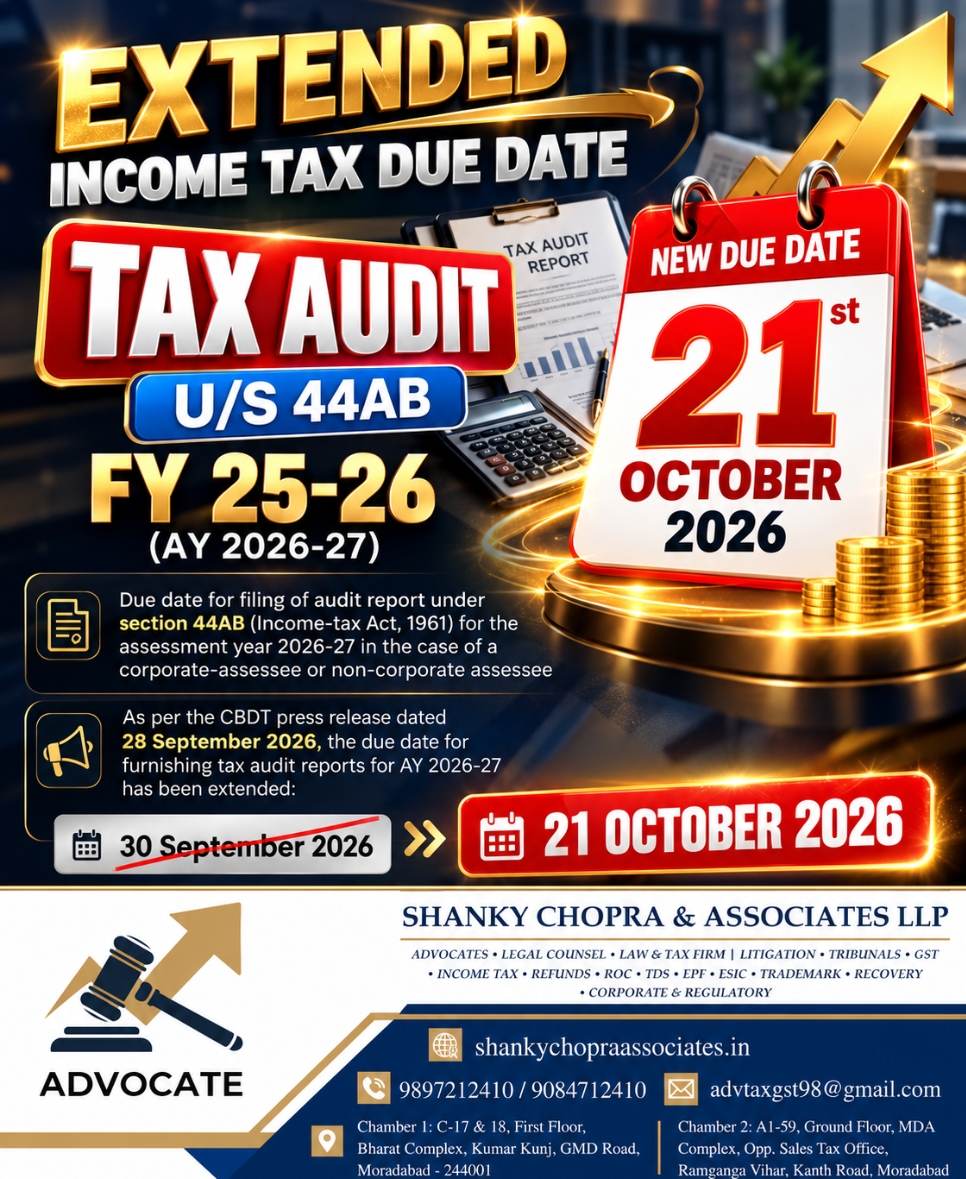
The Central Board of Direct Taxes (CBDT) has extended the due date for furnishing tax audit reports for Assessment Year (AY) 2026–27 from 30 September 2026 to **21 October 2026** for the specified category of taxpayers covered by the government announcement. The corresponding income tax return filing deadline for this category has also been extended from 31 October 2026 to 21 November 2026.
This extension is important for businesses, professionals, partnership firms and companies that are required to comply with the applicable tax audit provisions. Taxpayers should understand the revised deadlines, determine whether tax audit is mandatory in their case and prepare the necessary financial records before filing.
Shanky Chopra & Associates LLP provides tax and legal consultancy services to businesses and taxpayers in Moradabad, Delhi, Noida, Meerut, Ghaziabad and other parts of India.
## 1. Latest Tax Audit Due Date for FY 2025–26
The tax audit deadline is an important compliance date for taxpayers whose accounts are required to be audited under the Income-tax Act, 1961.
As per the CBDT press release dated 28 September 2026, the revised dates for the specified category are as follows:
- **Financial Year:** 2025–26
- **Assessment Year:** 2026–27
- **Original tax audit report deadline:** 30 September 2026
- **Extended tax audit report deadline:** 21 October 2026
- **Original income tax return deadline for the specified category:** 31 October 2026
- **Extended income tax return deadline:** 21 November 2026
The extension was announced through the CBDT's official communication, with a formal circular issued in this regard. Taxpayers should verify the applicability of the extension to their particular filing category before relying on these dates.
## 2. What Is a Tax Audit Under Section 44AB?
Section 44AB of the Income-tax Act, 1961, provides for a tax audit in specified cases involving business or professional income. The purpose of a tax audit is to examine the taxpayer's books of accounts and furnish the prescribed audit report.
A tax audit helps ensure that financial information, turnover, expenses, deductions and other relevant particulars are properly reported. It also supports compliance with the applicable income tax provisions.
Tax audit requirements may apply to:
- Proprietorship businesses.
- Partnership firms and LLPs.
- Companies carrying on business or profession.
- Professionals covered by the applicable audit provisions.
- Taxpayers opting for presumptive taxation where the statutory conditions trigger an audit requirement.
The applicability of Section 44AB depends on the nature of the activity, turnover or gross receipts, presumptive taxation provisions and other statutory conditions. Every business is not automatically required to obtain a tax audit merely because it has a GST registration.
## 3. Who Is Required to Get a Tax Audit?
Tax audit applicability should be assessed separately for every taxpayer based on the relevant financial year and applicable legal provisions.
### Business taxpayers
For a business, the general turnover threshold under Section 44AB(a) is more than ₹1 crore. However, the threshold may increase to ₹10 crore where both cash receipts and cash payments do not exceed the prescribed 5% limits, subject to the applicable statutory conditions.
Taxpayers should examine the relevant turnover, receipts, payments and exclusions before determining whether an audit is necessary.
### Professionals
Specified professionals, including persons carrying on eligible professional activities, may be required to obtain a tax audit when gross receipts exceed the applicable threshold. The general threshold under Section 44AB(b) is ₹50 lakh, subject to the relevant provisions.
### Presumptive taxation cases
Taxpayers using presumptive taxation provisions under Sections 44AD, 44ADA or 44AE should carefully examine the applicable conditions. In certain circumstances, declaring income below the prescribed presumptive amount or otherwise failing to meet statutory conditions may trigger audit requirements.
Therefore, the audit decision should not be made solely on the basis of turnover. The taxpayer's actual circumstances and the relevant provisions must be considered.
## 4. Documents Required for Income Tax Audit
Proper documentation helps in completing the audit efficiently and reducing the risk of errors or inconsistencies.
The commonly required records include:
**Financial records**
- Books of accounts, including cash book and ledger.
- Trial balance and financial statements.
- Bank statements and bank reconciliation statements.
- Details of loans, advances and capital accounts.
**Business records**
- Sales invoices and purchase bills.
- Expense vouchers and supporting documents.
- Details of stock and inventory, where applicable.
- Fixed asset register and depreciation working.
- Details of creditors and debtors.
**Tax compliance records**
- Income tax computation and advance tax details.
- TDS and TCS statements and reconciliations.
- GST returns and sales reconciliation, where applicable.
- Details of statutory payments and deductions.
- Details of related-party transactions and other prescribed disclosures, where applicable.
The exact documents required depend on the nature and size of the business, the accounting system followed and the applicable audit reporting requirements.
## 5. Importance of GST and Income Tax Reconciliation
Businesses registered under GST should ensure that their sales and financial records are properly reconciled before finalising the tax audit.
Differences may arise between books of accounts, GSTR-1, GSTR-3B, annual GST returns and the turnover reported in the income tax return. These differences should be reviewed and explained with supporting records.
Common reasons for differences include:
- Invoices reported in an incorrect GST reporting category.
- Credit notes and debit notes.
- Sales returns and cancelled invoices.
- Advances and timing differences.
- Export sales and exempt or non-GST supplies.
- Differences in the accounting and GST reporting periods.
- Errors in data entry or classification.
Similarly, purchase expenses, GST input tax credit, TDS and other tax-related balances should be reviewed for consistency.
A proper reconciliation process can help identify errors before the final tax audit report and income tax return are furnished.
## 6. Tax Audit Report Forms: Form 3CA, Form 3CB and Form 3CD
The applicable tax audit report forms depend on the taxpayer's circumstances.
**Form 3CA** is generally used when the taxpayer's accounts are already required to be audited under another law.
**Form 3CB** is generally used when the accounts are not required to be audited under another law but a tax audit is required under Section 44AB.
**Form 3CD** contains the prescribed particulars and disclosures accompanying the applicable tax audit report.
The relevant form and reporting requirements should be determined by the qualified Chartered Accountant conducting the audit. Taxpayers should provide complete and accurate information to support the required disclosures.
## 7. What Should Businesses Do Before the Extended Deadline?
Although the due date has been extended, taxpayers should not delay their compliance work until the last day.
The following steps can help:
1. Finalise the books of accounts for FY 2025–26.
2. Reconcile sales, purchases, expenses and bank transactions.
3. Review GST returns and TDS compliance.
4. Check depreciation, loans, capital accounts and other financial balances.
5. Identify transactions requiring special tax treatment or disclosure.
6. Provide supporting documents and explanations to the appointed Chartered Accountant.
7. Review the audit report and ensure that it is furnished within the applicable deadline.
8. Confirm the corresponding income tax return deadline and complete return filing separately, as required.
The tax audit report and income tax return are separate compliance requirements. Completing one does not automatically mean that the other has also been filed.
## 8. Consequences of Missing the Tax Audit Deadline
Failure to comply with applicable tax audit requirements may result in consequences under the Income-tax Act.
Section 271B provides for a penalty for failure to get accounts audited or furnish the audit report as required under Section 44AB. The penalty is generally 0.5% of total sales, turnover or gross receipts, subject to a maximum of ₹1,50,000.
However, Section 273B provides that a penalty may not be imposed where the taxpayer establishes reasonable cause for the failure, subject to the applicable legal requirements.
Taxpayers should not assume that a penalty will automatically be imposed in every delayed case, nor should they assume that an extension or reasonable-cause argument applies without examining the facts.
Where a compliance delay has occurred, the taxpayer should preserve relevant records, identify the reason for the delay and obtain appropriate professional advice.
## 9. Income Tax and Tax Audit Consultancy in Delhi NCR and Uttar Pradesh
Businesses often require professional assistance with tax audit coordination, income tax returns, GST reconciliation, TDS compliance and responses to departmental notices.
Shanky Chopra & Associates LLP provides tax and legal consultancy services to businesses and taxpayers based in Moradabad and serves clients across Delhi, Noida, Meerut, Ghaziabad and other locations, depending on the nature of the engagement.
Our services include:
- Income tax return filing assistance.
- Tax audit compliance coordination.
- GST registration and return filing.
- GST notices, replies and appeals.
- Income tax notices and appeal-related assistance.
- TDS and TCS compliance.
- Accounting and financial reconciliation.
- ROC filings and company compliance.
- Business registration and related regulatory support.
Our objective is to help businesses maintain organised financial records, understand their compliance obligations and address tax-related matters with appropriate professional guidance.
## 10. Frequently Asked Questions
**Q1. What is the extended tax audit due date for FY 2025–26?**
For the specified category covered by the CBDT extension, the deadline for furnishing the tax audit report for AY 2026–27 is 21 October 2026.
**Q2. What is the revised ITR deadline for taxpayers covered by this extension?**
The corresponding income tax return deadline for the specified category has been extended to 21 November 2026. Other categories of taxpayers may have different deadlines.
**Q3. Is every business required to get a tax audit?**
No. Tax audit applicability depends on the relevant turnover or gross receipt thresholds, presumptive taxation provisions and other statutory conditions.
**Q4. Does GST registration automatically make a business liable for a tax audit?**
No. GST registration alone does not automatically create a requirement for a tax audit under Section 44AB.
**Q5. Who conducts a tax audit under Section 44AB?**
The tax audit must be conducted by a Chartered Accountant eligible under the applicable law. A tax consultant can assist with records, reconciliation and compliance coordination, but the statutory audit must be performed and reported by an eligible professional.
**Q6. Should businesses wait until the extended due date to prepare their documents?**
No. Businesses should finalise their accounts and provide the required documents as early as possible to reduce the risk of last-minute errors and filing delays.
## Conclusion
The extension of the tax audit report deadline to 21 October 2026 provides additional time to complete the relevant compliance requirements for the specified category of taxpayers for FY 2025–26. However, businesses should first confirm whether Section 44AB applies to them and whether the revised deadline covers their particular filing category.
Maintaining accurate books, reconciling GST and income tax records and preparing the required audit documentation are important steps towards timely compliance.
For assistance with tax audit coordination, income tax compliance, GST matters and related business requirements, contact **Shanky Chopra & Associates LLP** for professional guidance.
### Contact Details
**Shanky Chopra & Associates LLP**
Website: https://shankychopraassociates.in
Phone: 9897212410 / 9084712410
Email: advtaxgst98@gmail.com
Office: Moradabad, Uttar Pradesh
Serving clients across Moradabad, Delhi, Noida, Meerut, Ghaziabad and other parts of India.
*Disclaimer: This article is for general informational purposes only and is not a substitute for individual tax or legal advice. Please verify the applicable provisions, official CBDT circulars and filing requirements for your specific circumstances before acting.*
**Official reference:** CBDT press release dated 28 September 2026 and Circular No. 7/2026 relating to the extension of filing timelines for AY 2026–27.
Have Questions? We're Here to Help
Get expert advice from SHANKY CHOPRA & ASSOCIATES LLP. Reach out to discuss your requirements.