
GSTR-1 Due Date for September 2026: Important GST Filing Update
# GSTR-1 Due Date for September 2026: GST Return Filing Guide for Businesses
Goods and Services Tax (GST) compliance is an essential responsibility for registered businesses in India. One of the most important requirements is filing GSTR-1, which contains details of outward supplies of goods and services made during a particular tax period. Accurate and timely filing helps businesses maintain proper tax records, report sales correctly and reduce the possibility of GST-related discrepancies.
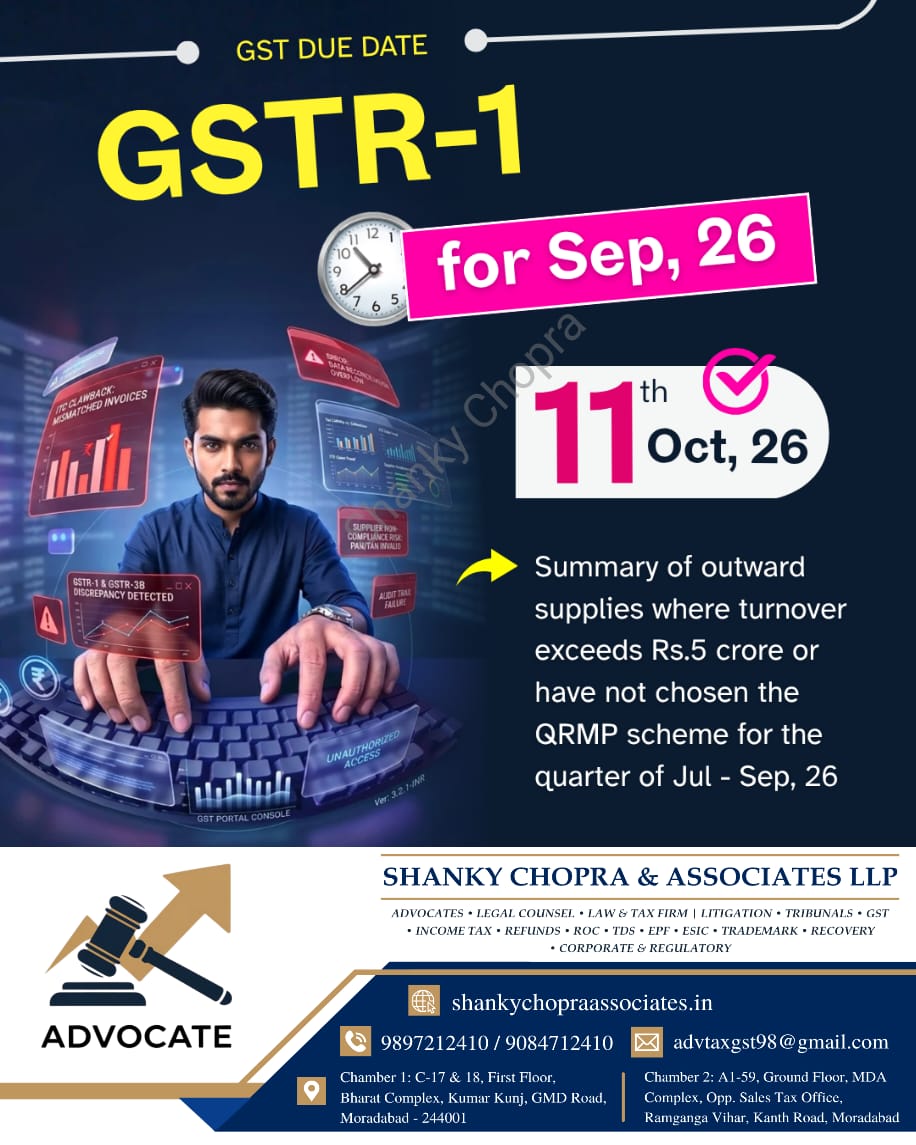
For the September 2026 tax period, the regular monthly GSTR-1 due date is **11 October 2026**, subject to any applicable government notification or extension. Businesses should verify their filing frequency and applicable due date on the official GST portal before submission.
Shanky Chopra & Associates LLP provides GST consultancy, return filing assistance, reconciliation services and taxation support for businesses in Moradabad, Kanth and nearby areas of Uttar Pradesh.
## 1. What Is GSTR-1 Under GST?
GSTR-1 is a statement of outward supplies that registered taxpayers generally use to report their sales transactions to the GST department. It contains information about taxable supplies, invoices issued to registered customers, sales to unregistered persons where reporting is required, credit notes, debit notes, amendments and other prescribed details.
The information furnished in GSTR-1 is important because it contributes to the GST reporting system and helps recipients view relevant supplier-reported invoice information through the portal.
Businesses should ensure that the information reported in GSTR-1 agrees with their sales registers, accounting records and supporting invoices. Errors in GSTIN, invoice values, tax rates or place of supply may create reconciliation issues for the supplier and the recipient.
## 2. GSTR-1 Due Date for September 2026
The applicable due date depends on whether the taxpayer follows monthly filing or the Quarterly Return Monthly Payment (QRMP) scheme.
* **Monthly filers:** The regular due date for GSTR-1 for September 2026 is 11 October 2026.
* **Quarterly filers under QRMP:** The regular due date for quarterly GSTR-1 for the July–September 2026 quarter is generally 13 October 2026, subject to applicable rules and notifications.
* **Special categories:** Certain taxpayers may have different reporting requirements or exclusions under GST law.
Taxpayers should not assume that every registered business has the same filing schedule. The applicable requirement should be checked according to the taxpayer's registration category, filing frequency and eligibility.
Late filing may attract applicable late fees and other consequences under GST law. If the government announces an extension, taxpayers should follow the relevant official notification.
## 3. Who Is Required to File GSTR-1?
GSTR-1 is generally required to be furnished by regular taxpayers registered under GST, subject to applicable statutory exceptions.
Businesses with an aggregate annual turnover exceeding the prescribed QRMP eligibility limit generally cannot opt for that scheme. Eligible taxpayers within the prescribed turnover limit may choose quarterly filing, subject to the scheme's conditions.
The choice between monthly and quarterly filing affects the reporting calendar and the frequency of return submission. Businesses should review their GST registration details and filing status rather than relying solely on their turnover or the practice followed by another business.
Certain categories of taxpayers, including specified composition taxpayers and other excluded categories, follow different compliance requirements.
## 4. Important Details to Check Before Filing GSTR-1
Before submitting the return, businesses should review the following information carefully.
### Sales invoices
Verify invoice numbers, dates, taxable values, GST rates and tax amounts. Ensure that invoices are reported in the correct tax period and that duplicate entries are avoided.
### GSTIN of customers
For business-to-business transactions, confirm the customer's GSTIN and other required invoice details. Incorrect GSTIN reporting can cause invoices to appear incorrectly in the recipient's records.
### Credit notes and debit notes
Review all credit notes and debit notes issued during the relevant period. Report them in the appropriate sections and ensure that the underlying transactions are correctly reflected.
### Export and special transactions
Businesses undertaking exports, supplies to special economic zones or other transactions requiring specific reporting should check the applicable reporting requirements and supporting documentation.
### Amendments and corrections
If an earlier invoice was reported incorrectly, determine whether an amendment is required and whether it can be made within the applicable statutory time limits.
A structured review before filing can help businesses avoid preventable errors and reduce future reconciliation work.
## 5. Relationship Between GSTR-1 and GSTR-3B
GSTR-1 and GSTR-3B serve different purposes but are closely connected.
GSTR-1 primarily reports details of outward supplies. GSTR-3B is a summary return used to declare relevant supplies, input tax credit and tax liabilities, and to discharge the applicable tax liability.
The figures reported in these returns should be reviewed for consistency. Differences may arise due to reporting mistakes, amendments, timing issues, credit notes, classification errors or other legitimate reasons. However, unexplained differences can lead to questions from the department.
Businesses should reconcile their sales register, GSTR-1, GSTR-3B and electronic liability records. Any difference should be investigated and supported by appropriate documentation.
A reconciliation process is particularly useful for businesses having multiple branches, high invoice volumes or transactions involving different GST rates.
## 6. GSTR-1 and Input Tax Credit Reconciliation
Although GSTR-1 primarily concerns outward supplies, its accuracy can also affect customers' input tax credit reconciliation.
Recipients may compare their purchase registers with the invoice information available through GSTR-2B. If a supplier fails to report an invoice correctly or reports an incorrect GSTIN, the recipient may face a mismatch while reconciling purchase records.
Businesses should therefore maintain communication with their customers regarding genuine invoice reporting issues and correct eligible errors through the prescribed GST procedures.
Recipients should independently verify the conditions applicable to input tax credit under GST law. The appearance of an invoice in a statement does not, by itself, establish that every statutory condition for claiming credit has been satisfied.
## 7. Common Mistakes During GSTR-1 Filing
Several avoidable mistakes can create compliance difficulties:
1. Reporting an incorrect GSTIN or invoice number.
2. Entering an incorrect taxable value or GST amount.
3. Omitting invoices from the return.
4. Reporting transactions in the wrong tax period.
5. Failing to account for credit notes and debit notes.
6. Not reconciling the return with the sales register.
7. Ignoring differences between GSTR-1 and GSTR-3B.
8. Assuming that a previously submitted return can be edited directly without following the prescribed amendment procedure.
To reduce these risks, taxpayers should review the return carefully before submission and preserve copies of invoices, reconciliation statements and relevant working papers.
## 8. What Happens If GSTR-1 Is Filed Late?
Failure to furnish GSTR-1 within the prescribed time may result in late fees under the applicable provisions. Other compliance consequences may arise depending on the taxpayer's circumstances and the relevant legal provisions.
The actual amount payable depends on the applicable law, the nature of the default, the relevant tax period and any applicable relief or notification.
Taxpayers should not calculate their liability using assumptions alone. They should verify the amount displayed on the GST portal and examine the applicable provisions before making payment.
If a delay occurred because of a genuine portal issue, businesses should preserve grievance reference numbers, screenshots, emails, ticket responses and other relevant evidence. Such documentation may be useful when explaining the circumstances to the department, although it does not automatically guarantee waiver of a statutory fee or penalty.
## 9. Why Professional GST Consultancy Can Help
GST compliance involves more than entering invoice details into an online form. Businesses must maintain accurate books, classify transactions correctly, reconcile returns and respond appropriately when discrepancies arise.
Professional GST assistance may help businesses with:
* GST registration and amendment applications.
* Monthly and quarterly GST return filing.
* GSTR-1 and GSTR-3B reconciliation.
* Input tax credit verification and reconciliation.
* GST notices, replies and supporting documentation.
* GST refund applications and related follow-up.
* GST audit assistance and compliance reviews.
* Appeals and representation in applicable tax proceedings.
The exact service required depends on the taxpayer's business activities and compliance position. Timely review can help identify issues before they develop into more complicated disputes.
## 10. GST Consultant in Moradabad and Kanth, Uttar Pradesh
Businesses in Moradabad, Kanth and nearby commercial areas often require assistance with GST return filing, tax reconciliation, documentation and departmental correspondence.
Shanky Chopra & Associates LLP provides taxation and legal support services for traders, manufacturers, service providers, professionals and companies. The firm's services include GST compliance, income tax matters, TDS, ROC filings, company and LLP compliance, refunds and related regulatory work.
Businesses looking for a GST consultant in Moradabad or Kanth can seek professional assistance with return preparation, reconciliation and compliance documentation according to their individual requirements.
Maintaining proper records and reviewing returns regularly can help businesses improve their compliance processes and respond more effectively to tax-related queries.
## 11. Practical GST Compliance Checklist for September 2026
Before completing your September 2026 GST compliance, consider the following checklist:
* Confirm whether monthly or quarterly filing applies.
* Verify the relevant GSTR-1 due date on the official portal.
* Reconcile outward supplies with the sales register.
* Check invoice details and customer GSTINs.
* Review credit notes, debit notes and amendments.
* Confirm that GSTR-1 and GSTR-3B figures are appropriately reconciled.
* Preserve invoices and supporting accounting records.
* Save the return acknowledgement and ARN after submission.
* Review any outstanding notices or portal communications.
This checklist provides a useful starting point, but additional checks may be necessary depending on the nature of the business and its transactions.
## Conclusion
GSTR-1 is a key component of GST compliance in India. Businesses should understand their applicable filing frequency, verify the due date, report outward supplies accurately and reconcile their returns with the books of accounts.
For the September 2026 tax period, the regular monthly GSTR-1 due date is 11 October 2026, while eligible quarterly filers generally follow the applicable quarterly schedule. Any government extension or special instruction should be verified through official sources.
Shanky Chopra & Associates LLP offers GST consultancy, return filing assistance, reconciliation and taxation support for businesses in Moradabad, Kanth and nearby areas.
For professional assistance with GST returns, tax reconciliation, notices and business compliance, visit **shankychopraassociates.in** or contact the firm directly.
**Shanky Chopra & Associates LLP**
Advocates | Legal Counsel | Law & Tax Firm
Website: https://shankychopraassociates.in
Phone: 9897212410 / 9084712410
Email: [advtaxgst98@gmail.com](mailto:advtaxgst98@gmail.com)
Office: Moradabad, Uttar Pradesh, India
Have Questions? We're Here to Help
Get expert advice from SHANKY CHOPRA & ASSOCIATES LLP. Reach out to discuss your requirements.