
# Delhi High Court Upholds Withholding of GST Refund During Pending Anti-Evasion Investigation **Case Name:** Devi Electronics (P.) Ltd. v. Commissioner CGST, Delhi South **Court:**
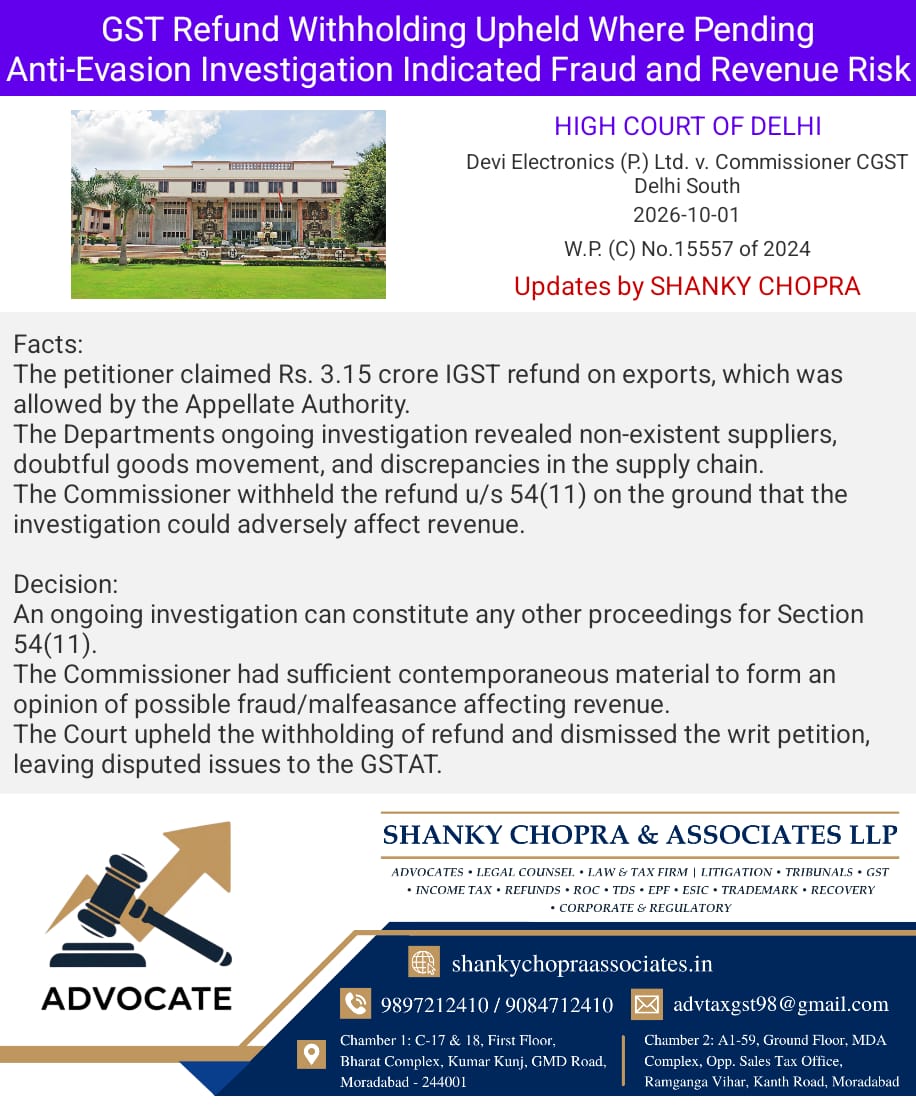
# Delhi High Court GST Refund Judgment 2026: Withholding of IGST Refund During Pending Anti-Evasion Investigation
## Introduction
GST refunds play a significant role in maintaining the working capital and financial stability of businesses, particularly exporters. Under the Goods and Services Tax (GST) framework, eligible exporters may claim refunds of Integrated Goods and Services Tax (IGST) paid on exports or refunds of accumulated Input Tax Credit (ITC), subject to applicable legal provisions and prescribed conditions. However, refund claims may become contentious when the GST Department initiates an investigation involving suspected tax evasion, questionable suppliers, or irregularities in the supply chain.
The reported decision in *Devi Electronics (P.) Ltd. v. Commissioner CGST, Delhi South*, W.P. (C) No. 15557 of 2024, dated 1 October 2026, before the Delhi High Court, concerns the withholding of an IGST refund during an ongoing anti-evasion investigation.
According to the case summary available for this article, the petitioner had claimed an export-related IGST refund of approximately ₹3.15 crore. Although the refund had been allowed by the appellate authority, the Department withheld the amount in view of concerns arising from an ongoing investigation.
The matter highlights the relationship between a taxpayer's right to claim a legitimate GST refund and the statutory powers of tax authorities to protect government revenue where suspected fraud or other irregularities require examination.
**Important:** The following discussion is based on the supplied case summary. The official judgment should be consulted to verify the precise findings, statutory interpretation, and operative directions before citing this decision in legal proceedings.
## 1. Background and Facts of the Case
The petitioner, Devi Electronics (P.) Ltd., had claimed an IGST refund of approximately ₹3.15 crore in connection with exports. The refund claim had reportedly been allowed by the appellate authority.
Subsequently, an anti-evasion investigation conducted by the GST Department raised concerns regarding certain transactions forming part of the petitioner's supply chain. The reported concerns included the existence of suppliers, the movement of goods, and discrepancies in the underlying transactions.
According to the available summary, the Commissioner withheld the refund by invoking Section 54(11) of the Central Goods and Services Tax Act, 2017, on the ground that releasing the amount could adversely affect government revenue.
The petitioner challenged the action before the Delhi High Court. The dispute therefore raised an important question: can a refund that has been allowed at an earlier stage nevertheless be withheld where an investigation indicates possible fraud or other irregularities affecting revenue?
The answer depends on the statutory requirements, the material available to the competent authority, and the circumstances of the particular case.
## 2. Legal Framework Under Section 54(11) of the CGST Act
Section 54 of the CGST Act, 2017, governs refunds under the GST regime. It provides the statutory framework for claiming refunds and addresses different aspects of refund processing.
Section 54(11) deals with withholding a refund in specified circumstances. Broadly, it concerns situations involving an appeal or other proceedings where the Commissioner forms the requisite opinion that granting the refund may adversely affect revenue, having regard to the statutory conditions.
The provision is important because the release of a substantial refund may have financial implications where the underlying transactions are suspected to involve fraud or tax evasion.
However, Section 54(11) should not be interpreted as giving the Department an unrestricted power to withhold every refund merely because an inquiry is pending. The authority must examine whether the particular circumstances fall within the provision and whether the statutory conditions for exercising the power are satisfied.
Taxpayers should therefore examine the actual withholding order, the reasons recorded by the authority, the proceedings relied upon, and the relevant supporting material.
## 3. Why Was the GST Refund Withheld?
According to the supplied case summary, the Department's concerns related to suspected irregularities in the supply chain. These included questions regarding supplier existence, the movement of goods, and discrepancies in transactions associated with the refund claim.
Such issues can be significant in GST investigations because a refund claim may depend on the genuineness of the underlying transactions and compliance with applicable statutory requirements.
For example, investigators may examine whether goods were actually supplied, whether transportation documents correspond with invoices, whether suppliers were operating from their declared locations, and whether the documentary record supports the transactions reported in GST returns.
Nevertheless, an allegation or discrepancy should be distinguished from a final determination of tax liability or fraud. Each transaction must be examined in accordance with the applicable law and the evidence available.
In a refund-withholding dispute, the relevant question is not simply whether an investigation exists. It is whether the statutory conditions for withholding the particular refund have been met.
## 4. Decision of the Delhi High Court
As reported in the supplied summary, the Delhi High Court upheld the withholding of the refund and dismissed the writ petition, leaving disputed issues to the GST Appellate Tribunal (GSTAT).
The summary indicates that the Court considered the ongoing investigation relevant to the statutory framework governing refund withholding and that contemporaneous material concerning possible fraud or malfeasance affecting revenue was significant to the Commissioner's decision.
The reported outcome underscores that an earlier order allowing a refund does not necessarily conclude every question concerning the subsequent withholding of the amount where the law permits such action in specified circumstances.
At the same time, the precise scope of the ruling must be determined from the official judgment. It would be incorrect to conclude that every pending anti-evasion investigation automatically authorises the withholding of a GST refund.
The decision should be applied by considering its actual reasoning, the statutory language, and the factual circumstances involved.
## 5. Can a Pending Investigation Justify Withholding a GST Refund?
This is one of the most important issues for businesses facing GST refund delays.
A pending investigation may be relevant where the applicable statutory provision permits withholding and the competent authority has the material necessary to form the opinion required by law. However, the mere existence of an investigation should not be treated as conclusive proof of wrongdoing.
The following factors may require examination:
* Whether the authority has invoked the correct statutory provision.
* Whether the proceedings relied upon fall within the scope of that provision.
* Whether the order records the relevant reasons and statutory basis for withholding.
* Whether the available material supports the concern regarding adverse revenue implications.
* Whether the authority has complied with applicable procedural requirements.
* Whether the taxpayer has documentary evidence supporting the genuineness of the transactions.
These considerations are relevant both to the Department's exercise of statutory powers and to a taxpayer's assessment of available remedies.
A taxpayer should obtain and carefully examine the withholding order rather than relying exclusively on oral explanations or the general statement that an investigation is pending.
## 6. Impact on Exporters and Businesses Claiming IGST Refunds
Exporters often depend on timely GST refunds to maintain working capital, pay suppliers, meet salary obligations, and finance continuing business operations.
When a substantial refund is withheld, the financial consequences may be serious. Funds that would otherwise be available for business use can remain blocked while the investigation or related proceedings continue.
The issue is especially important for businesses that undertake regular exports and operate on relatively narrow working-capital margins.
To reduce avoidable disputes, exporters should maintain a comprehensive documentary record, including:
* Export invoices and relevant shipping bills.
* Purchase invoices and supplier details.
* E-way bills, where applicable.
* Transport documents and delivery evidence.
* Payment records and relevant bank statements.
* GST returns and refund application records.
* Records supporting the movement and receipt of goods.
* Correspondence with suppliers and the tax authorities.
The exact documents required will depend on the transaction and the legal issue under examination.
Maintaining organised records can help businesses respond effectively to inquiries and identify discrepancies before they develop into larger disputes.
## 7. Practical Steps When a GST Refund Is Withheld
Businesses whose GST refunds have been withheld should adopt a structured approach.
### Step 1: Obtain the Relevant Order
The taxpayer should obtain the withholding order and identify the provision invoked, the reasons recorded, and the proceedings relied upon by the authority.
### Step 2: Reconcile the Transactions
The taxpayer should reconcile purchase invoices, supplier information, GST returns, e-way bills, transportation records, export documents, and payment evidence, as relevant to the case.
### Step 3: Prepare an Evidence-Based Representation
Where appropriate, the taxpayer may submit a representation explaining the transactions, addressing the discrepancies identified by the Department, and enclosing supporting documentary evidence.
### Step 4: Examine the Legal Remedy
The appropriate remedy depends on the nature of the order, the procedural stage, the statutory provisions involved, and the availability of an alternative remedy. Depending on the circumstances, the taxpayer may need to consider departmental proceedings, an appeal where maintainable, or constitutional remedies before a competent court.
### Step 5: Monitor the Proceedings
The taxpayer should maintain a record of notices, replies, hearings, orders, and relevant deadlines. Delay in responding to a notice or pursuing an available remedy may complicate the matter.
Professional advice should be obtained before selecting a legal strategy because the appropriate course of action differs from case to case.
## 8. Important Lessons for GST Practitioners
The reported dispute offers several practical lessons for GST practitioners and businesses.
First, refund eligibility and refund withholding are related but distinct legal questions. An order allowing a refund does not, by itself, answer every question that may arise under a separate statutory power of withholding.
Second, the statutory authority must act within the boundaries of the applicable law. The existence of an investigation does not eliminate the need to satisfy the relevant legal requirements.
Third, contemporaneous records are particularly important in cases involving allegations about supplier existence, the movement of goods, or the genuineness of transactions.
Fourth, legal strategy should be based on the actual order and the complete record rather than on general statements about the Department's investigation.
Finally, taxpayers should avoid treating the reported decision as a universal rule. Its application will depend on the precise statutory provision, the facts, and the reasoning adopted by the Court.
## 9. Conclusion
The reported decision in *Devi Electronics (P.) Ltd. v. Commissioner CGST, Delhi South* highlights the legal issues that can arise when an export-related IGST refund is withheld during an anti-evasion investigation.
The dispute draws attention to Section 54(11) of the CGST Act, the importance of protecting government revenue, and the need to examine whether the statutory conditions for withholding a refund have been fulfilled.
For exporters and other taxpayers, the practical lesson is clear: maintain reliable transaction records, respond carefully to departmental inquiries, and examine the legal basis of any refund-withholding order.
Where a refund has been withheld, the taxpayer should assess the available legal remedies after reviewing the relevant documents and statutory provisions.
**Legal Disclaimer:** This article is intended solely for general informational and educational purposes and does not constitute legal advice. The case details and outcome described above are based on the supplied case summary and should be independently verified against the official judgment before publication as a definitive statement of law or use in legal proceedings.
**Published by: Shanky Chopra & Associates LLP**
Advocates • Legal Counsel • Law & Tax Firm
Services: GST Consultancy, GST Notices and Replies, GST Refunds, GST Appeals, Tax Litigation, Income Tax, ROC Compliance, and Corporate Legal Services.
Location: Moradabad, Uttar Pradesh, India.
Have Questions? We're Here to Help
Get expert advice from SHANKY CHOPRA & ASSOCIATES LLP. Reach out to discuss your requirements.