
GST Due Date 13 October 2026: GSTR-5 and GSTR-6 Filing for September 2026
# GST Due Date 13 October 2026: GSTR-5 and GSTR-6 Filing for September 2026
**Published by Shanky Chopra & Associates LLP | GST, Taxation and Legal Compliance**
## Introduction: GST Return Filing Deadline in October 2026
Goods and Services Tax (GST) compliance is an important responsibility for registered taxpayers and businesses in India. Filing the applicable returns within the prescribed time helps maintain accurate tax records, supports proper reporting of transactions and reduces the risk of late fees and other consequences under GST law.
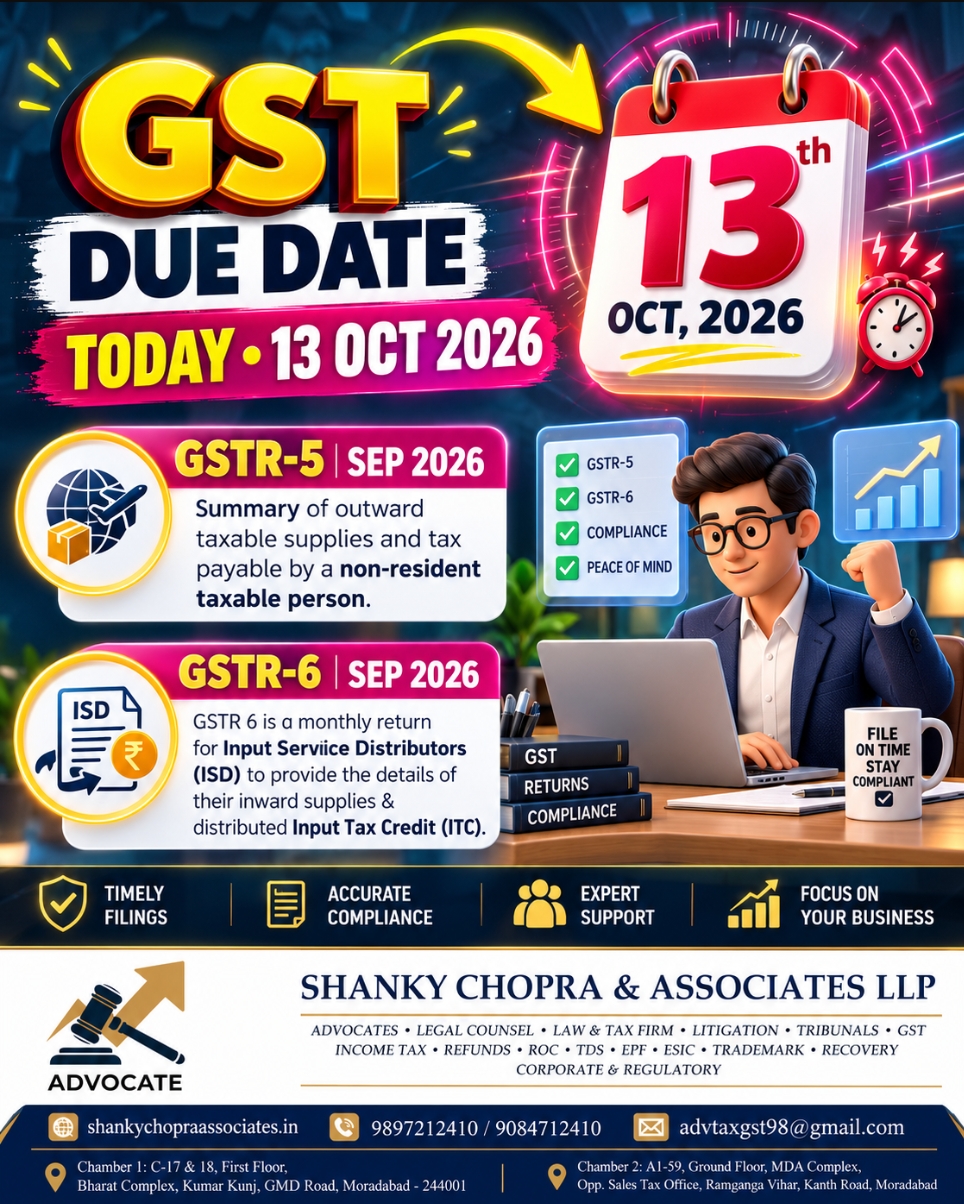
For the September 2026 tax period, **13 October 2026 is the scheduled due date for GSTR-5 and GSTR-6**, subject to applicable provisions and any official notification extending the deadline.
GSTR-5 is relevant to non-resident taxable persons registered under GST, whereas GSTR-6 applies to Input Service Distributors (ISDs). These returns serve different purposes and apply to different categories of registered persons.
Taxpayers should identify the return applicable to their registration, review their records and complete the filing process through the official GST portal. This article explains the purpose of both returns, their filing requirements, the importance of timely compliance and the assistance available from Shanky Chopra & Associates LLP in Moradabad and Kanth.
## 1. GSTR-5 Due Date for September 2026
The scheduled due date for filing GSTR-5 for the September 2026 tax period is **13 October 2026**.
GSTR-5 is the return applicable to a non-resident taxable person registered under the GST framework. Such persons may undertake taxable transactions in India without having a fixed place of business or residence in the country, subject to the applicable legal requirements.
The return is used to report relevant outward supplies, inward supplies, tax liability and other prescribed transaction details.
### Who Needs to File GSTR-5?
GSTR-5 is generally applicable to persons registered as non-resident taxable persons under GST. It is not the regular monthly return for every domestic GST-registered business.
The applicable filing requirements depend on the taxpayer's registration status, period of registration and activities carried out in India.
Non-resident taxable persons should review their registration validity and applicable filing period carefully. Where registration expires or business activities conclude, a special filing timeline may apply. The applicable deadline should therefore be verified instead of relying exclusively on the ordinary monthly due date.
### Important Details to Review Before Filing GSTR-5
Before filing the return, the taxpayer should review the following information:
* Details of taxable outward supplies.
* Applicable inward supply information.
* Taxable values and applicable GST rates.
* Integrated GST, Central GST and State GST liability, wherever applicable.
* Relevant invoices, debit notes and credit notes.
* Advances and adjustments, where applicable.
* Tax payment and registration-period details.
* Supporting documents and transaction records.
The information entered in the return should be consistent with the underlying books of account and supporting documents. Any discrepancy should be examined and corrected in accordance with the applicable GST provisions before submission.
## 2. GSTR-6 Due Date for September 2026
The scheduled due date for filing GSTR-6 for September 2026 is **13 October 2026**.
GSTR-6 is a monthly return applicable to an Input Service Distributor (ISD). An ISD receives invoices for input services and distributes eligible input tax credit to its eligible recipient units or registrations in accordance with the prescribed rules.
The purpose of GSTR-6 is to report relevant inward supply information and the distribution of eligible Input Tax Credit (ITC). Correct reporting is important because the distribution of credit must follow the applicable GST provisions and documentation requirements.
### Who Is Required to File GSTR-6?
Registered persons operating as Input Service Distributors are generally required to furnish GSTR-6 for the applicable tax period.
The ISD mechanism is relevant where input service credit is received centrally and must be distributed among eligible recipient registrations. The distribution must follow the applicable legal requirements, including the prescribed allocation methodology and relevant restrictions.
Businesses should not assume that every company with multiple branches automatically needs to file GSTR-6. Applicability depends on the registration structure, the nature of the input services and the relevant statutory requirements.
### Key Information Required for GSTR-6
Before filing GSTR-6, an ISD should review:
* Invoices received for input services.
* Supplier GSTIN and invoice particulars.
* Taxable values and tax amounts.
* Eligible and ineligible input tax credit.
* Credit notes and debit notes, where relevant.
* Credit distributed to eligible recipient registrations.
* Distribution ratios and supporting calculations.
* Differences between invoices, accounting records and GST portal information.
Proper reconciliation helps reduce the possibility of incorrect credit distribution and avoidable compliance issues.
## 3. Difference Between GSTR-5 and GSTR-6
Although both returns have a scheduled filing date of 13 October 2026 for the relevant monthly period, their purposes are different.
**GSTR-5** is designed for non-resident taxable persons and reports their applicable taxable transactions and tax-related particulars.
**GSTR-6** is designed for Input Service Distributors and reports relevant input service invoices and the distribution of eligible input tax credit.
The person responsible for filing, the information required and the purpose of the return differ. A taxpayer should therefore select the correct form according to the nature of their GST registration.
Understanding this distinction is important for businesses, accountants and tax professionals handling GST compliance for multiple clients.
## 4. How to Prepare for GST Return Filing
A structured preparation process can make GST return filing more accurate and efficient.
### Step 1: Identify the Applicable Return
Confirm whether the registration falls under the non-resident taxable person category or the Input Service Distributor category. Review the applicable tax period and registration details.
### Step 2: Collect Supporting Documents
Arrange the relevant invoices, credit notes, debit notes, accounting records and other supporting documents. The documentation required will depend on the return being filed.
### Step 3: Reconcile the Information
Compare the information available in the accounting records with the details required in the GST return. For GSTR-6, particular attention should be given to input service invoices and credit distribution.
### Step 4: Review Tax and Credit Calculations
Check taxable values, tax amounts and eligible credit calculations. Any differences should be investigated and resolved in accordance with the applicable rules.
### Step 5: File Through the Official GST Portal
Access the official GST portal and navigate to the relevant return filing section. Select the correct return period, review the prepared details and complete the applicable verification and filing formalities.
### Step 6: Preserve the Filing Records
After successful filing, retain the acknowledgement, return summary and supporting records. These documents can be useful for future reconciliation, audits and responding to departmental queries.
## 5. Why Timely GST Compliance Matters
Timely filing is an important part of maintaining GST compliance. Delayed filing may result in late fees or other consequences depending on the applicable statutory provisions and the facts of the case.
Accurate and timely reporting also supports better financial management, reliable tax records and smoother reconciliation of business transactions.
Taxpayers should not rely solely on general online calendars. They should check the official GST portal for the relevant return period and verify whether any notification has changed the ordinary due date.
Where a portal issue, registration problem or technical difficulty affects filing, the taxpayer should preserve relevant evidence, including screenshots, grievance reference numbers and communications received from the GST portal.
## 6. Common GST Return Filing Mistakes to Avoid
Some common compliance issues can be reduced through proper review and documentation.
**Incorrect return selection:** Filing the wrong return can create avoidable compliance problems. Confirm the registration category and applicable form before proceeding.
**Incomplete invoice details:** Missing or incorrectly entered invoice particulars may affect the accuracy of reporting.
**Incorrect ITC distribution:** ISDs should verify the eligibility and allocation of input tax credit before distributing it to recipient registrations.
**Ignoring registration validity:** Non-resident taxable persons should check whether an earlier deadline applies because of registration expiry or closure of business activities.
**Last-minute filing:** Waiting until the due date may leave insufficient time to address portal errors or missing documents.
**Failure to preserve records:** Keep filed returns, acknowledgements, reconciliation statements and supporting documents for future reference.
These precautions can improve the quality of GST compliance and help taxpayers identify issues before submitting their returns.
## 7. GST Consultancy and Tax Compliance Services in Moradabad and Kanth
Shanky Chopra & Associates LLP provides professional assistance in taxation, GST compliance and related legal and regulatory matters.
Businesses and taxpayers seeking GST consultancy in Moradabad, Kanth and nearby areas may require assistance with return preparation, reconciliation, documentation and compliance-related queries.
The firm's services include assistance relating to:
* GST registration and return filing.
* GST reconciliation and Input Tax Credit review.
* GST notices and departmental replies.
* GST refunds and appeals.
* Income Tax return and tax compliance assistance.
* TDS compliance.
* ROC and corporate compliance.
* Tax advisory and related legal matters.
The nature of assistance required depends on the taxpayer's business activities, registration category and specific compliance requirements.
For businesses managing multiple registrations or complex transactions, maintaining organised records and obtaining appropriate professional guidance can help improve compliance processes.
## 8. Frequently Asked Questions
### What is the GSTR-5 due date for September 2026?
The scheduled monthly due date is 13 October 2026, subject to applicable provisions and official extensions. Special deadlines may apply to certain non-resident taxable persons.
### What is the GSTR-6 due date for September 2026?
The scheduled due date is 13 October 2026, subject to any applicable notification extending the deadline.
### Who files GSTR-5?
GSTR-5 is generally filed by registered non-resident taxable persons for their applicable tax periods.
### Who files GSTR-6?
GSTR-6 is applicable to registered Input Service Distributors for reporting relevant inward supply details and distribution of eligible input tax credit.
### Can the due date be extended?
The competent authority may extend a prescribed deadline through an applicable notification. Taxpayers should verify the latest position on the official GST portal before filing.
### Where can taxpayers obtain GST filing assistance in Moradabad?
Taxpayers can contact Shanky Chopra & Associates LLP for professional assistance with GST return filing, reconciliation, tax advisory and related compliance matters.
## Conclusion
The scheduled GST return filing deadline of 13 October 2026 is relevant to GSTR-5 and GSTR-6 for the September 2026 tax period. Non-resident taxable persons and Input Service Distributors should identify their applicable requirements, review their records and complete the filing process in accordance with GST law.
Accurate reporting, timely filing and proper documentation are important elements of effective GST compliance. Taxpayers should also verify the latest due dates and notifications through the official GST portal.
For professional assistance with GST, taxation and regulatory compliance in Moradabad, Kanth and nearby areas, contact **Shanky Chopra & Associates LLP**.
**Website:** https://shankychopraassociates.in
**Contact:** 9897212410 / 9084712410
**Email:** [advtaxgst98@gmail.com](mailto:advtaxgst98@gmail.com)
*Disclaimer: This article is for general informational purposes only and should not be treated as individual legal or tax advice. Filing requirements and due dates should be verified against the applicable GST law, official portal and relevant notifications.*
Have Questions? We're Here to Help
Get expert advice from SHANKY CHOPRA & ASSOCIATES LLP. Reach out to discuss your requirements.