
# Form ADT-1 Due Date for FY 2025–26: Last Date, Rules
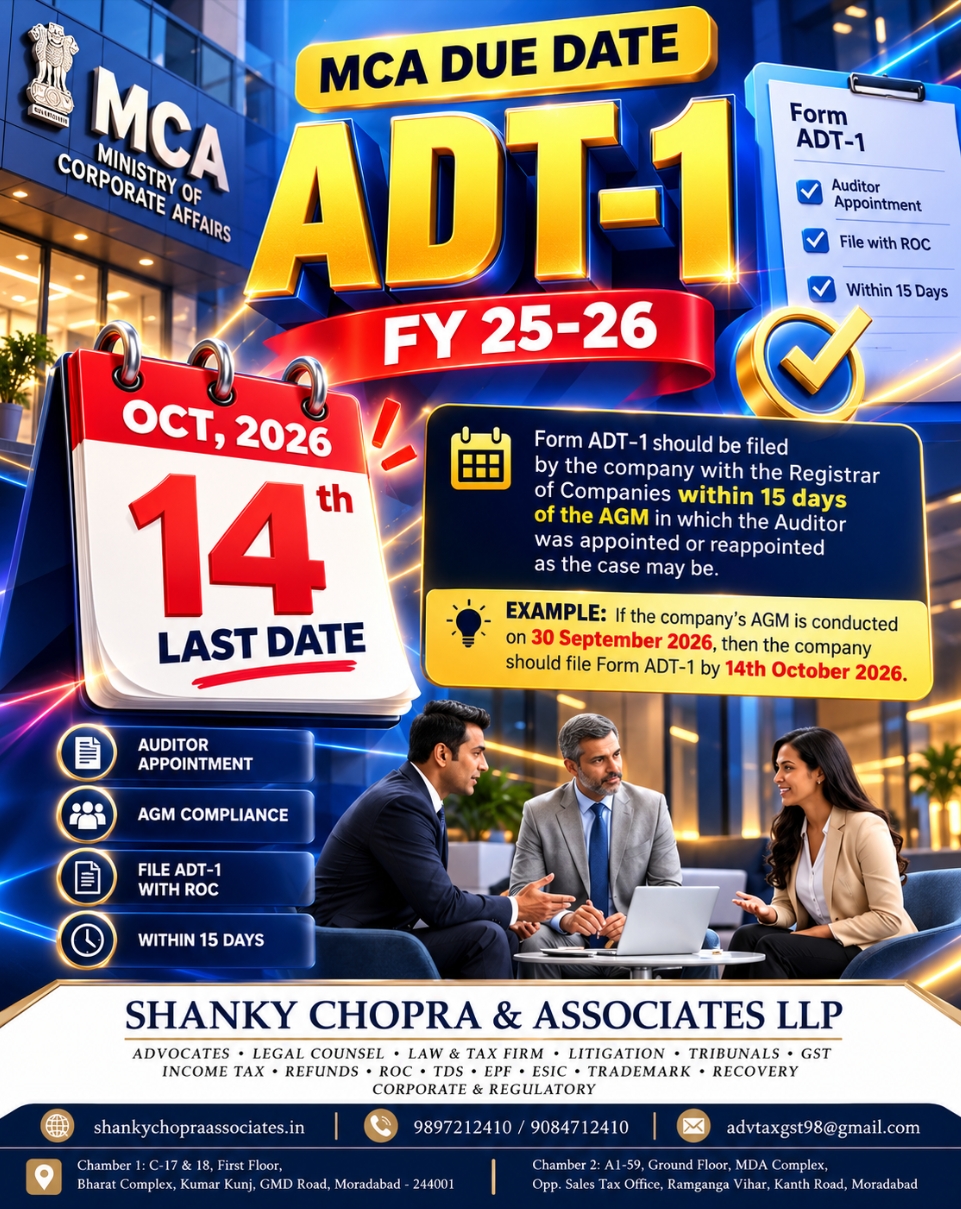
# Form ADT-1 Due Date 2026: Last Date, Filing Procedure, Rules and Documents
## Introduction
Form ADT-1 is an important statutory compliance form under the Companies Act, 2013. It is used by a company to intimate the Registrar of Companies (ROC) about the appointment of an auditor in the circumstances prescribed under the applicable law. Companies must understand the applicable filing requirements, calculate the due date correctly and maintain proper records of the auditor’s appointment.
For companies conducting their Annual General Meeting (AGM) for the financial year 2025–26, the date of the meeting and the nature of the auditor’s appointment are important factors in determining the filing deadline.
If the relevant auditor appointment or reappointment takes place at an AGM held on 30 September 2026, the ordinary 15-day filing period ends on **15 October 2026**. Companies should complete the filing in advance to reduce the risk of last-minute technical problems or incomplete submissions.
## What Is Form ADT-1?
Form ADT-1 is the prescribed form for notifying the Registrar of Companies about the appointment of an auditor, as covered by the applicable provisions of the Companies Act, 2013 and the Companies (Audit and Auditors) Rules, 2014.
The form contains details relating to the company, the appointed auditor, the date of appointment and other information required by the MCA filing system. It helps maintain the statutory record of an auditor’s appointment.
Companies should distinguish between the appointment of an auditor, the continuation of an existing auditor and a fresh appointment or reappointment. The applicable filing requirement should be checked against the actual facts and the relevant statutory provisions.
## Form ADT-1 Due Date for FY 2025–26
The due date depends on the relevant appointment and the date on which the appointment is made.
For example, where the auditor is appointed or reappointed at an AGM held on 30 September 2026, the ordinary 15-day period is calculated as follows:
* AGM date: 30 September 2026
* Day 1: 1 October 2026
* Day 10: 10 October 2026
* Day 15: 15 October 2026
* General filing deadline: 15 October 2026
This calculation excludes the date of the meeting and begins counting from the following day.
The example assumes that the relevant appointment takes place at the AGM on 30 September 2026. If the appointment is made on another date or under different circumstances, the filing deadline must be determined accordingly. Companies should also check the latest MCA instructions and applicable rules before filing.
## Legal Provisions Governing Form ADT-1
### Section 139 of the Companies Act, 2013
Section 139 deals with the appointment and tenure of company auditors. The requirements applicable to a company depend on its type, the circumstances of the appointment and the relevant statutory provisions.
Companies should review the auditor’s tenure and the resolution or other appointment records before deciding what filing is required.
### Rule 4(2) of the Companies (Audit and Auditors) Rules, 2014
Rule 4(2) prescribes Form ADT-1 for giving notice to the Registrar regarding an auditor’s appointment in the circumstances covered by the rule.
The applicable form, instructions and amendments should be reviewed before submission. A company should not rely solely on a generic due-date calendar if the underlying appointment circumstances are different.
## When Is Form ADT-1 Required?
Form ADT-1 is relevant when a company is required to notify the ROC about an auditor’s appointment under the applicable law. This may include an appointment or reappointment at an AGM where the relevant provisions apply.
However, companies should not assume that a fresh ADT-1 must automatically be filed at every AGM. The need for filing depends on the appointment circumstances, auditor tenure and applicable statutory requirements.
Before filing, the company should confirm:
1. Whether a fresh appointment or reappointment has taken place.
2. The date and nature of the appointment.
3. The auditor’s existing tenure, where relevant.
4. The applicable statutory provision and filing requirement.
5. The due date under the relevant rule.
## Documents and Information Required for Form ADT-1
The company should collect the necessary information and supporting documents before starting the filing process. Depending on the circumstances and the current MCA form instructions, these may include:
* Company name and Corporate Identity Number (CIN).
* Registered office address and contact details.
* Date of the AGM or relevant appointment meeting.
* Details of the auditor or audit firm.
* Auditor’s membership number and other prescribed particulars.
* Relevant appointment resolution or meeting records, where required.
* Consent and eligibility documentation, as applicable.
* Appointment period and other details requested in the form.
* Required declarations and attachments.
* Digital Signature Certificate (DSC) and authorised signatory details.
The company should verify all particulars against its statutory records and the current MCA instruction kit. Incorrect information or missing attachments can lead to filing difficulties.
## Step-by-Step Procedure to File Form ADT-1
### Step 1: Verify the auditor’s appointment
Review the relevant resolution, appointment details, auditor’s consent and eligibility documentation, as applicable. Confirm that the appointment has been made in accordance with the relevant provisions.
### Step 2: Determine the due date
Identify the actual date of appointment and calculate the applicable filing period. For an appointment made at an AGM on 30 September 2026, the ordinary 15-day deadline is 15 October 2026.
### Step 3: Access the MCA portal
Visit the official Ministry of Corporate Affairs website and locate the applicable Form ADT-1 filing facility. Use the current version of the form and follow the instructions displayed on the portal.
### Step 4: Enter company and auditor details
Fill in the company particulars, appointment information and auditor details accurately. Cross-check the entries against the company’s records before proceeding.
### Step 5: Upload the required attachments
Attach the documents required under the current form instructions. Ensure that the files are readable, complete and uploaded in the prescribed format.
### Step 6: Authenticate and submit the form
Complete the applicable digital authentication and submission process. Review the form carefully before final submission to minimise errors.
### Step 7: Save the acknowledgement
After submission, retain the Service Request Number (SRN), challan, filed form and acknowledgement with the company’s statutory records. These documents may be useful for future compliance reviews and verification.
## What Happens If Form ADT-1 Is Filed Late?
Late filing may attract additional fees or other consequences under the applicable provisions and fee rules. The amount payable depends on the relevant requirements, the duration of delay and the circumstances of the case.
Companies should not assume that the consequences are identical in every situation. The applicable MCA fee schedule and legal provisions should be checked before calculating any amount payable.
If a filing deadline has already passed, the company should review the status of the appointment, determine the applicable filing requirements and complete the necessary compliance as soon as practicable.
## Common Mistakes to Avoid
Companies can reduce avoidable filing errors by taking care of the following points:
* Calculating the deadline from an incorrect date.
* Confusing the AGM date with the date of an appointment made separately.
* Assuming that a fresh ADT-1 is mandatory at every AGM.
* Entering incorrect company or auditor particulars.
* Uploading incomplete or incorrect attachments.
* Using outdated form instructions.
* Waiting until the last date to begin the filing process.
* Failing to preserve the SRN and acknowledgement.
A proper review before submission helps maintain accurate corporate records and supports timely ROC compliance.
## Importance of Timely MCA and ROC Compliance
MCA compliance is an important responsibility for companies and their authorised officers. Maintaining accurate records, tracking filing deadlines and reviewing statutory requirements can help businesses manage their corporate obligations more efficiently.
A compliance calendar can help companies track AGM dates, auditor appointments, annual returns, financial statement filings and other applicable ROC requirements. The calendar should be tailored to the company’s circumstances instead of using the same dates for every entity.
Businesses should also periodically review changes to company law, MCA forms and filing procedures. Current instructions should take priority over outdated checklists or general online articles.
## MCA and ROC Compliance Services in Moradabad
Shanky Chopra & Associates LLP provides professional support for corporate compliance, ROC filings, GST, income tax, TDS, accounting and related taxation matters.
Companies, LLPs and business owners in Moradabad, Kanth and nearby areas may seek assistance with compliance documentation, filing requirements, statutory records and related corporate matters.
Professional review can help businesses identify the relevant requirements, organise supporting documents and maintain a structured compliance process. The exact service required depends on the company’s circumstances and the applicable law.
## Frequently Asked Questions
### 1. What is the due date of Form ADT-1 for FY 2025–26?
The deadline depends on the date and circumstances of the auditor’s appointment. Where the relevant appointment or reappointment takes place at an AGM on 30 September 2026, the ordinary 15-day deadline is 15 October 2026.
### 2. Is Form ADT-1 required every year?
Not automatically. The requirement for a fresh filing depends on the appointment or reappointment and the applicable statutory provisions.
### 3. Which provision governs Form ADT-1?
Section 139 of the Companies Act, 2013, read with Rule 4(2) of the Companies (Audit and Auditors) Rules, 2014, is relevant to the prescribed notice of auditor appointment.
### 4. Can Form ADT-1 be filed before the last date?
Yes. Companies should prepare the form and supporting documents in advance and complete the filing as soon as the necessary appointment details are finalised.
### 5. Where is Form ADT-1 filed?
The form is filed electronically through the Ministry of Corporate Affairs (MCA) portal in accordance with the applicable filing process.
### 6. What should a company do if it misses the deadline?
The company should review the applicable legal requirements, determine the relevant fees or consequences and complete the necessary filing promptly.
## Conclusion
Form ADT-1 is an important ROC compliance requirement for notifying the Registrar about an auditor’s appointment in the circumstances covered by the applicable law. Companies should verify the appointment details, calculate the deadline correctly and use the latest MCA filing instructions.
Where the relevant appointment or reappointment takes place at an AGM on 30 September 2026, the ordinary 15-day filing deadline is 15 October 2026. Advance preparation and proper documentation can help companies avoid preventable filing delays.
**Shanky Chopra & Associates LLP**
Corporate Compliance | ROC Filing | GST | Income Tax | Accounting
Moradabad, Uttar Pradesh
Website: https://shankychopraassociates.in
Phone: 9897212410 / 9084712410
Email: [advtaxgst98@gmail.com](mailto:advtaxgst98@gmail.com)
*Disclaimer: This article is for general informational purposes only. The applicable legal provisions, current MCA instructions and facts of the individual appointment should be reviewed before filing.*
Have Questions? We're Here to Help
Get expert advice from SHANKY CHOPRA & ASSOCIATES LLP. Reach out to discuss your requirements.