
# 57th GST Council Meeting 2026: Major GST Reforms, Penalty Changes, Registration and Refund Updates **The 57th GST Council Meeting, held on 8 October 2026 in New Delhi
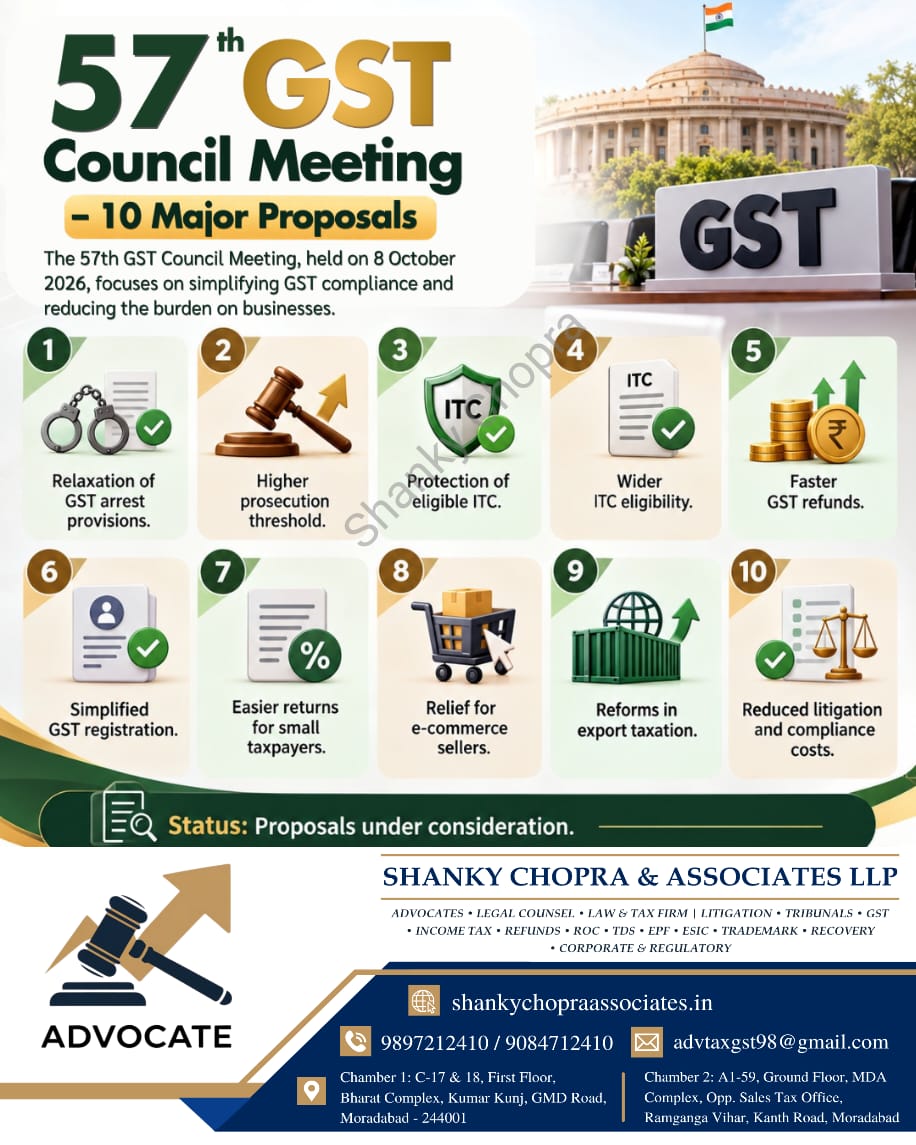
# 57th GST Council Meeting 2026: Major GST Reforms, Penalty Changes, ITC, Refunds and Registration Updates
The 57th GST Council Meeting was held on 8 October 2026 in New Delhi under the chairpersonship of the Union Finance and Corporate Affairs Minister, Nirmala Sitharaman. The meeting focused on improving the Goods and Services Tax (GST) framework through procedural reforms, easier compliance, improved refund mechanisms, input tax credit (ITC) changes and rationalisation of certain enforcement provisions.
The recommendations are important for traders, manufacturers, service providers, exporters, e-commerce sellers, startups and other GST-registered businesses. The objective is to simplify tax administration, reduce unnecessary disputes, improve working capital and make GST compliance more convenient.
In this article, we explain the key recommendations of the 57th GST Council Meeting and their potential implications for taxpayers.
## 1. Key Highlights of the 57th GST Council Meeting
The major recommendations announced by the GST Council include:
* Removal of specified arrest provisions under GST.
* Increase in the prosecution threshold from ₹1 crore to ₹5 crore.
* Reduction in the general penalty from ₹25,000 to ₹10,000.
* Wider eligibility for input tax credit and refunds.
* Simplification of GST registration and return-related procedures.
* Faster GST refund processing to improve business liquidity.
* Common standards for GST notices and adjudication proceedings.
* Simplification of registration for eligible small e-commerce sellers.
* Measures to facilitate exports of services.
* Intelligence-based and authorised interception of goods in transit.
* An optional scheme approved in principle for eligible small consumer-facing businesses with turnover up to ₹5 crore.
These recommendations cover several important areas of GST administration. Their practical application will depend on the relevant notifications, amendments, implementation dates and eligibility conditions.
## 2. GST Prosecution Threshold Increased from ₹1 Crore to ₹5 Crore
One of the major recommendations concerns the prosecution threshold under the GST framework.
The GST Council recommended increasing the monetary threshold for prosecution from ₹1 crore to ₹5 crore. The proposal is intended to rationalise criminal proceedings and provide relief in eligible cases involving GST-related offences.
For businesses, this may help reduce exposure to prosecution in cases falling below the revised threshold, subject to the applicable legal provisions and exceptions.
However, taxpayers must understand that the prosecution threshold is different from the threshold for determining tax liability. A higher prosecution threshold does not automatically cancel GST demands, interest, penalties or recovery proceedings.
Businesses should maintain proper accounting records, reconcile GST returns, verify input tax credit and preserve supporting documents. If a notice or investigation is pending, its consequences should be assessed under the law applicable to the relevant period.
## 3. Recommendations Regarding Arrest Provisions
The Council recommended removing specified arrest provisions under GST.
This proposal represents an important development in the enforcement framework and reflects an effort to make tax administration more predictable for businesses.
Nevertheless, the recommendation should not be interpreted as complete immunity from GST investigations or enforcement action. Assessment, scrutiny, recovery and other proceedings may continue wherever authorised by law.
Taxpayers receiving departmental communications should examine the allegations, statutory provisions and supporting evidence before deciding how to respond. Any benefit arising from the proposed changes must be evaluated in light of the final legal amendments and their commencement dates.
## 4. General Penalty Recommended to Be Reduced from ₹25,000 to ₹10,000
The GST Council recommended reducing the general penalty from ₹25,000 to ₹10,000.
The proposed reduction may provide relief in cases covered by the relevant general penalty provisions. However, it should not be assumed that every GST penalty will automatically be reduced to ₹10,000.
Different defaults may attract different penalties under the CGST Act, IGST Act, applicable rules or other relevant provisions.
For example, a penalty relating to a specific offence, an incorrect ITC claim or an e-way bill violation must be examined under the provision applicable to that situation.
Before paying a penalty or accepting an allegation, taxpayers should review the notice, identify the legal provision and determine whether the proposed amount is legally sustainable.
## 5. Wider Eligibility for Input Tax Credit
Input tax credit is one of the most important aspects of GST compliance because it directly affects a business's tax cost and cash flow.
The Council recommended wider eligibility for input tax credit and measures to address issues associated with the existing ITC framework.
Businesses should continue to reconcile purchase registers with GSTR-2B, verify supplier invoices, review GSTR-3B disclosures and maintain appropriate supporting records.
An ITC claim should not be made solely because an invoice appears in an accounting system. Taxpayers must satisfy the applicable statutory conditions, restrictions and documentation requirements.
Where a business has faced ITC mismatch notices, supplier-related discrepancies or disputes over credit eligibility, the case should be reviewed carefully. The actual benefit of any relaxation will depend on the relevant amendment or clarification.
## 6. Faster GST Refunds and Improved Working Capital
The Council recommended measures to speed up GST refunds and improve working capital for businesses.
Refund delays can affect exporters, manufacturers and other businesses that regularly accumulate eligible tax credits. Faster processing may help eligible taxpayers access funds more efficiently.
Businesses claiming GST refunds should ensure that their returns, invoices, bank details and supporting documents are accurate and consistent.
Exporters should maintain relevant export invoices, shipping documentation, payment records and other documents required for their claims. Businesses seeking refunds arising from an inverted duty structure should verify the applicable eligibility conditions and calculation method.
A refund recommendation does not guarantee approval of every claim. Applications remain subject to applicable legal requirements, verification and prescribed procedures.
## 7. Simplified GST Registration for Small E-Commerce Sellers
The Council recommended a simplified registration mechanism for eligible small suppliers of goods selling through e-commerce operators in states or union territories where they do not have a physical presence.
Under the recommended mechanism, eligible sellers may be able to declare an e-commerce operator's warehouse in the relevant state or union territory as their principal place of business, subject to prescribed conditions.
The proposal is intended to help small sellers expand their online businesses without necessarily establishing a separate physical business location in every state where they sell goods.
The recommendation includes an input tax credit-related limit of ₹2.5 lakh per month for the specified mechanism. This should not be confused with a general annual turnover threshold.
E-commerce sellers should verify the final conditions, registration process and applicable compliance requirements before relying on this facility.
## 8. Simplification of GST Returns and Compliance
The Council also recommended reforms relating to GST returns and the adjustment of liabilities and input tax credit in returns, with the objective of minimising mismatches and reducing unnecessary notices or intimations.
Return-related errors can arise because of incorrect invoice reporting, differences between GSTR-1 and GSTR-3B, supplier amendments, credit notes, debit notes or accounting discrepancies.
Businesses should periodically undertake the following reconciliations:
* GSTR-1 versus GSTR-3B.
* GSTR-2B versus purchase registers and ITC claimed.
* Electronic cash ledger and electronic credit ledger.
* GST returns versus books of accounts.
* E-invoices and e-way bills versus underlying transactions, wherever applicable.
These checks can help identify errors early and support accurate reporting. Taxpayers should follow the existing portal procedures until the relevant new mechanism becomes legally operational.
## 9. Common Standards for GST Notices and Adjudication
The Council recommended common standards for GST notices and proceedings.
Standardised procedures can improve clarity and consistency in departmental communications. Taxpayers should be able to understand the issue raised, the legal basis of the allegation and the information required for a response.
When receiving a GST show-cause notice, audit objection or demand order, businesses should:
1. Identify the relevant financial year and tax period.
2. Examine the statutory provisions cited in the notice.
3. Reconcile the disputed amount with the books of accounts and GST returns.
4. Collect invoices, payment proofs, ledgers and other supporting documents.
5. Calculate tax, interest and penalty separately.
6. Submit a reasoned reply within the prescribed time.
7. Evaluate appeal or other remedies if an adverse order is passed.
A properly documented response can help clarify the facts and address the department's concerns. Whether a demand or penalty is sustainable must be decided according to the facts and applicable law.
## 10. Measures to Facilitate Exports of Services
The Council recommended changes intended to facilitate the export of services.
One important proposal concerns the definition of export of services under the IGST Act. The recommendation seeks to remove a specified condition concerning establishments of distinct persons, which may facilitate refund claims for eligible Indian service providers supplying services to or through their foreign offices or branches.
The Council also recommended clarification concerning permissible payment in foreign exchange or Indian rupees for exports of goods and services.
Businesses involved in international service transactions should review their contracts, invoices, payment records and place-of-supply requirements. Whether a transaction qualifies as an export of services depends on the applicable statutory conditions and the final amendments.
Exporters should not assume that every overseas transaction automatically qualifies for zero-rating or a refund.
## 11. Movement of Goods and Interception Procedures
The Council recommended measures to facilitate the movement of goods across states and promote intelligence-based, authorised interception.
These recommendations are relevant to transporters, wholesalers, manufacturers, distributors and traders whose goods move across state boundaries.
Businesses should ensure that tax invoices, delivery challans, e-way bills, vehicle details and goods descriptions are accurate wherever required.
If goods are detained during transportation, the taxpayer should examine the detention documents, the grounds recorded by the officer and the applicable statutory procedure. Appropriate documentary evidence should be preserved before responding to the proceedings.
The proposed reforms should be applied according to the final legal provisions and implementation instructions.
## 12. Optional Scheme for Small Consumer-Facing Businesses
The Council approved in principle an optional scheme for eligible small consumer-facing businesses with turnover up to ₹5 crore.
The proposal may be relevant to qualifying businesses dealing directly with consumers. However, the scheme's detailed eligibility conditions, tax treatment, exclusions and implementation requirements must be verified from official notifications and instructions.
Businesses should assess the scheme's impact on pricing, tax liability, input tax credit and customer transactions before opting for it.
Turnover alone should not be treated as sufficient proof of eligibility.
## 13. What Should Businesses Do After the 57th GST Council Meeting?
Businesses should use the recommendations as a reason to review their compliance systems rather than assume that all proposed changes are already effective.
The following actions are advisable:
* Review pending GST notices, audits and appeals.
* Reconcile GSTR-1, GSTR-3B, GSTR-2B and accounting records.
* Check eligibility for ITC and refunds under applicable provisions.
* Maintain proper invoices, e-way bills and payment records.
* Monitor official notifications and amendments.
* Review e-commerce registration requirements if selling across states.
* Seek professional advice before acting on any proposed relaxation.
These steps can help businesses manage compliance risks and prepare for changes once they become legally effective.
## Conclusion
The 57th GST Council Meeting held on 8 October 2026 recommended important reforms concerning prosecution thresholds, arrest provisions, general penalties, input tax credit, refunds, registration, exports and GST compliance procedures.
The recommendations are aimed at simplifying GST administration, supporting businesses and reducing avoidable procedural difficulties. Their practical impact will depend on the final legal changes, applicable dates and conditions.
Businesses should monitor official announcements, maintain accurate records and review their tax positions before claiming any new benefit.
**Need professional assistance with GST registration, GST audit, ITC reconciliation, GST notices, appeals or refunds?**
**Shanky Chopra & Associates LLP** provides taxation and GST compliance support to businesses and taxpayers in Moradabad, Kanth and surrounding areas.
Professional services include GST registration, return filing, audit assistance, notice replies, appeals, refund applications, ITC reconciliation and tax advisory.
Stay updated with the latest GST developments to support accurate compliance and informed business decisions.
Have Questions? We're Here to Help
Get expert advice from SHANKY CHOPRA & ASSOCIATES LLP. Reach out to discuss your requirements.