
Income Tax Recovery Update 2026: Arrest & Prison Detention Provisions Under Rule 225 Removed
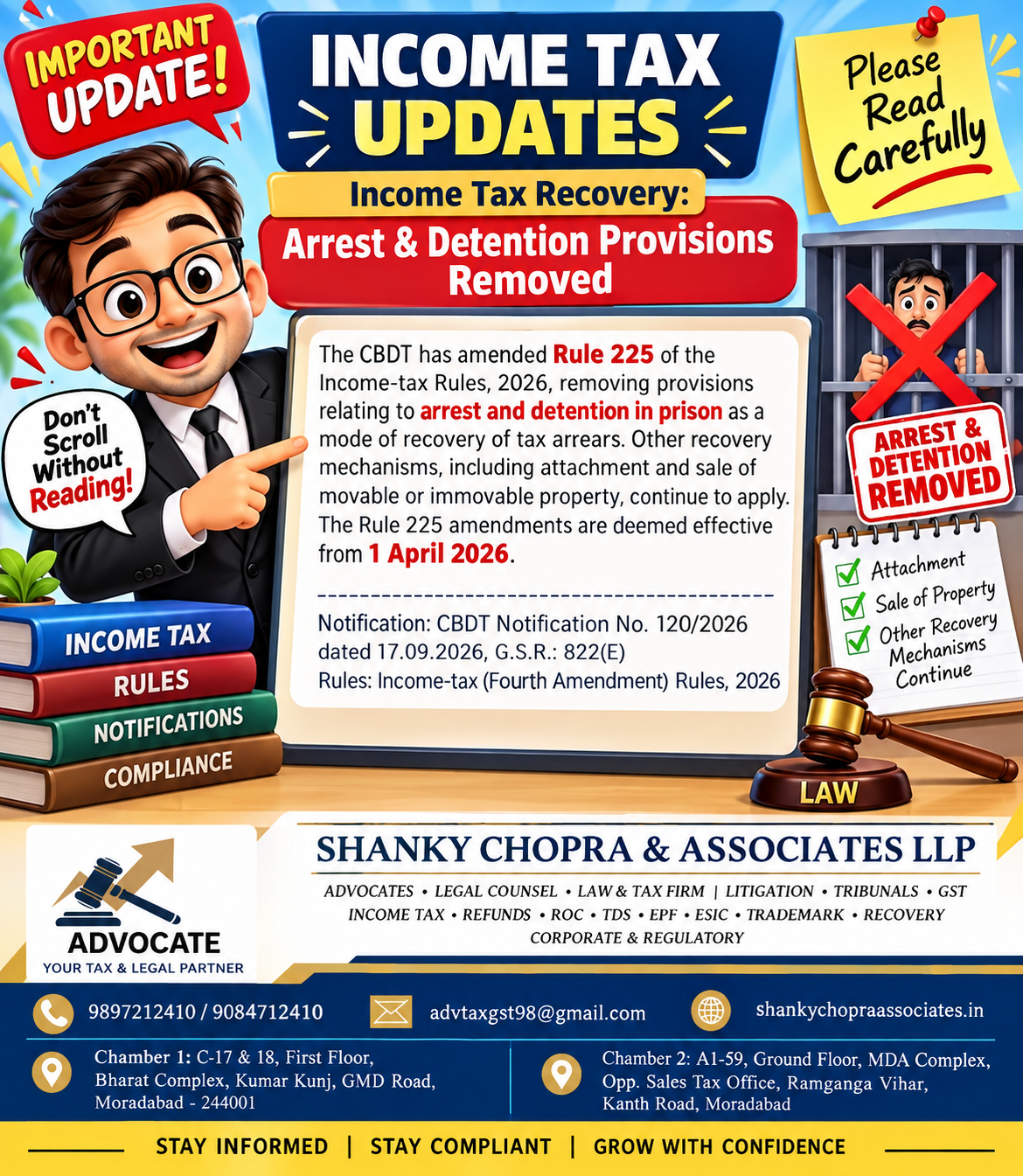
Income Tax Recovery Update 2026: Rule 225 Amendment, Arrest and Prison Detention Removed
The Income Tax recovery framework has witnessed an important change in 2026 with the amendment of Rule 225 of the Income-tax Rules, 2026. The amendment relates specifically to the methods that may be used for recovery of outstanding tax arrears and has attracted considerable attention among taxpayers, businesses, professionals and tax practitioners.
According to the notification referred to in this update, provisions relating to arrest and detention in prison as a mode of recovery of tax arrears have been removed from Rule 225 with effect from 1 April 2026. However, taxpayers should understand that this amendment does not mean that outstanding Income Tax demands have been cancelled or that the Income Tax Department has lost all its recovery powers.
Other statutory recovery mechanisms, including appropriate proceedings concerning attachment and sale of property, can continue to operate subject to the applicable provisions of the Income-tax law.
For taxpayers and businesses in Moradabad, Kanth, Delhi and across India, understanding the distinction between an outstanding tax demand and the methods available for its recovery is important for making appropriate compliance and legal decisions.
What Is Rule 225 of the Income-tax Rules, 2026?
Rule 225 forms part of the framework dealing with recovery of tax arrears under the Income-tax Rules, 2026. Tax arrears may arise when a taxpayer has an outstanding amount payable pursuant to an income-tax proceeding, assessment, demand, penalty or other legally enforceable liability.
The Income Tax Department has various statutory mechanisms through which an outstanding demand may be recovered. These mechanisms are intended to facilitate collection of amounts that are legally due and recoverable.
The 2026 amendment is significant because it changes the provisions concerning arrest and detention in prison as a recovery mechanism under Rule 225.
For taxpayers searching for information regarding Income Tax recovery in Moradabad, Income Tax notices in Kanth, tax demand assistance in Delhi, income tax appeals and tax litigation, this distinction is particularly important.
What Is the Major Change in 2026?
The major change is that provisions relating to arrest and detention in prison for recovery of tax arrears have been removed from Rule 225.
In simple terms, the amendment changes the recovery framework by removing this particular mechanism from the relevant rule.
This should be understood carefully.
The amendment does not mean:
-
Outstanding Income Tax demands are automatically waived.
-
Existing tax liabilities are automatically cancelled.
-
Taxpayers can ignore Income Tax notices.
-
The Income Tax Department cannot initiate any recovery proceedings.
-
All forms of attachment or recovery have been abolished.
-
Every prosecution provision under the Income-tax Act has been removed.
Instead, the change specifically concerns the arrest and detention mechanism contained in the relevant recovery framework.
Effective Date of the Amendment
The amendment is stated to take effect from 1 April 2026.
The notification referred to in the update is:
CBDT Notification No. 120/2026
Date: 17 September 2026
G.S.R. 822(E)
Income-tax (Fourth Amendment) Rules, 2026
Taxpayers and professionals should examine the actual notification and amended statutory text when relying upon the amendment in a particular legal proceeding.
Does the Amendment Cancel Outstanding Tax Demand?
No.
This is one of the most important points for taxpayers.
If an Income Tax demand is outstanding on the Income Tax portal, the amendment to Rule 225 does not by itself cancel or extinguish that demand.
A demand may have arisen because of:
-
Income Tax assessment
-
Reassessment proceedings
-
Adjustment of tax credits
-
TDS or TCS-related discrepancies
-
Incorrect reporting
-
Addition made during assessment
-
Penalty proceedings
-
Interest liability
-
Non-payment or short payment of tax
-
Other statutory proceedings
Therefore, taxpayers should first determine why the demand has arisen and whether it is legally payable.
Can Income Tax Department Still Recover Outstanding Tax?
The amendment should not be understood as abolition of Income Tax recovery.
Other recovery mechanisms provided under the applicable law may continue to be available, depending upon the nature of the demand and the stage of proceedings.
Recovery measures may include statutory action concerning:
1. Attachment of Property
Where legally permissible, property may be subjected to attachment proceedings in accordance with the applicable recovery provisions.
2. Sale of Attached Property
Where the statutory conditions are fulfilled, attached property may be dealt with through the prescribed recovery process, including sale.
3. Recovery Through Other Statutory Mechanisms
The Income-tax Act and Rules contain different mechanisms for recovery of amounts that are legally due. The availability and application of a particular mechanism depend upon the facts of the case and the applicable statutory provisions.
Therefore, a taxpayer should not ignore a recovery notice merely because Rule 225 has been amended.
Difference Between Tax Demand and Tax Recovery
A taxpayer should understand the difference between a tax demand and tax recovery.
A tax demand represents an amount that the department says is payable by the taxpayer.
Recovery is the process through which the department seeks to collect an amount that is legally recoverable.
For example, a taxpayer may receive an assessment order creating a demand. The taxpayer may then:
-
Accept the demand and pay it;
-
Seek rectification where legally available;
-
File an appeal;
-
Seek appropriate stay or protection where applicable;
-
Challenge an incorrect demand through the prescribed legal mechanism.
The appropriate course depends upon the facts and procedural status of the matter.
What Should a Taxpayer Do After Receiving an Income Tax Recovery Notice?
A taxpayer should not simply ignore a recovery notice.
The first step should be to identify:
What is the demand?
Which assessment year does it relate to?
What order created the demand?
Is an appeal pending?
Has the demand already been paid?
Is there any mismatch in tax credit?
Has any rectification application been filed?
Is any stay applicable?
Is the demand correctly appearing on the Income Tax portal?
A detailed examination of these issues can help determine the appropriate response.
Income Tax Demand Verification
Before paying an old or disputed demand, taxpayers should verify the demand carefully.
For example, an old demand may sometimes require reconciliation with:
-
Previous tax payments
-
TDS credits
-
Advance tax
-
Self-assessment tax
-
Tax deducted or collected at source
-
Rectification orders
-
Appeal orders
-
Revised returns
-
Previous correspondence with the department
Therefore, simply looking at the outstanding amount on the portal may not always provide the complete legal history of the demand.
Income Tax Appeals and Recovery
Where an assessee disputes an assessment or demand, an appeal may be available under the applicable provisions.
However, filing an appeal and obtaining protection from recovery are separate procedural issues and should be examined carefully.
A taxpayer should maintain complete records of:
-
Assessment order
-
Demand notice
-
Appeal filing
-
Grounds of appeal
-
Acknowledgement
-
Payment details
-
Stay application, wherever applicable
-
Departmental communications
-
Rectification applications
-
Orders passed by appellate authorities
Professional examination becomes particularly useful where substantial demand is involved.
Importance for Businesses in Moradabad
Businesses operating in Moradabad regularly deal with Income Tax compliance, TDS, advance tax, tax audits, assessments and departmental communications.
A business may receive a demand due to a difference between the information reported in the return and information available with the department.
For businesses in Moradabad, timely verification of Income Tax demands can help identify whether the amount is:
-
Correctly payable;
-
Already paid;
-
Incorrectly calculated;
-
Related to a tax credit issue;
-
Subject to appeal;
-
Eligible for rectification or another statutory remedy.
Professional Income Tax consultation in Moradabad can therefore involve not only return filing but also demand verification, assessment assistance and representation.
Income Tax Services in Kanth
Taxpayers and businesses in Kanth may also face Income Tax notices, assessment proceedings, TDS discrepancies, outstanding demands and recovery-related communications.
A taxpayer receiving a notice should carefully examine the document rather than relying only on a message or summary displayed on the portal.
Depending upon the matter, professional assistance may be required for:
-
Income Tax notice reply
-
Demand verification
-
Assessment proceedings
-
Appeal drafting
-
Rectification
-
Tax recovery matters
-
TDS/TCS reconciliation
-
Tax compliance
-
Litigation and representation
A structured review can help the taxpayer understand the legal and procedural position before taking further action.
Income Tax Assistance in Delhi
Delhi is a major centre for businesses, professionals, companies and tax litigation. Taxpayers operating in Delhi may have complex assessment and recovery matters involving multiple assessment years.
Businesses with operations in Delhi and Uttar Pradesh may also require coordinated tax compliance and litigation support.
Professional assistance may cover:
-
Income Tax assessment
-
Income Tax appeals
-
Tax demand reconciliation
-
Recovery proceedings
-
TDS matters
-
Corporate tax compliance
-
GST and Income Tax coordination
-
Representation before tax authorities
-
Drafting of legal submissions
Why Taxpayers Should Not Ignore Old Demands
Old Income Tax demands should not automatically be considered irrelevant.
A taxpayer should check the complete history of the demand and determine its present status.
An old demand may be connected with an earlier assessment, appeal or tax credit issue. In some cases, records may need to be reconciled before deciding whether payment, rectification, appeal or another remedy is appropriate.
Maintaining proper documentation is therefore extremely important.
Does Removal of Arrest Mean No Legal Consequences?
Not necessarily.
The removal of arrest and prison detention as a recovery mechanism under Rule 225 should not be interpreted as removal of every consequence that may arise under income-tax law.
Different provisions of the Income-tax Act deal with different matters, including:
-
Assessment
-
Interest
-
Penalties
-
Recovery
-
Prosecution
-
Offences
-
Appeals
-
Revision
-
Rectification
Each provision has its own legal requirements.
Therefore, a taxpayer should not make a broad conclusion about prosecution or other statutory consequences merely on the basis of the Rule 225 amendment.
Importance of Professional Tax Consultation
Income Tax law involves multiple interconnected provisions. A demand shown on the portal may require examination of the underlying assessment order and supporting documents.
A professional tax consultant or taxation advocate can assist in reviewing:
-
Income Tax notices
-
Assessment orders
-
Outstanding demands
-
TDS mismatches
-
Appeal documents
-
Rectification issues
-
Recovery notices
-
Tax payment records
-
Supporting evidence
-
Applicable statutory provisions
The exact remedy depends upon the facts, limitation period, procedural stage and applicable law.
Income Tax and GST Support in Moradabad, Kanth & Delhi
Tax compliance today often requires coordination between Income Tax, GST, TDS and other regulatory requirements.
Businesses in Moradabad, Kanth and Delhi may require assistance with both routine compliance and litigation-related matters.
Shanky Chopra & Associates LLP provides professional taxation and legal assistance relating to:
-
Income Tax
-
GST
-
Income Tax Notices
-
GST Notices
-
Assessments
-
Appeals
-
Tax Recovery Matters
-
Tax Demand Reconciliation
-
TDS/TCS Matters
-
GST Returns
-
GST Appeals
-
Refunds
-
Tax Litigation
-
Compliance Support
Professional assistance can help taxpayers understand the nature of a demand and identify the appropriate statutory course of action.
Conclusion
The amendment to Rule 225 of the Income-tax Rules, 2026 represents an important development in the framework relating to recovery of tax arrears. The removal of arrest and detention in prison as a recovery mechanism is significant, but it should not be misunderstood as cancellation of outstanding Income Tax demands or abolition of other recovery procedures.
Taxpayers should continue to comply with valid Income Tax demands and notices while carefully examining whether a demand is correct, disputed, already paid, under appeal or eligible for another statutory remedy.
For taxpayers and businesses in Moradabad, Kanth, Delhi and across India, timely professional review of Income Tax notices, demands, assessment orders and recovery proceedings can help ensure that the appropriate legal and procedural steps are taken.
Shanky Chopra & Associates LLP provides professional assistance in Income Tax, GST, tax notices, assessments, appeals, refunds, recovery matters, compliance and taxation litigation.
Stay Informed | Stay Compliant | Grow With Confidence.
Income Tax Recovery 2026, Rule 225 Income Tax Rules, Income Tax demand, Income Tax notice, Income Tax recovery Moradabad, Income Tax Advocate Moradabad, Tax Consultant Moradabad, Income Tax Consultant Kanth, Income Tax Advocate Kanth, Income Tax Consultant Delhi, Income Tax Advocate Delhi, tax recovery lawyer, Income Tax appeal, Income Tax litigation, tax demand notice, Income Tax legal support, Shanky Chopra & Associates LLP.
Have Questions? We're Here to Help
Get expert advice from SHANKY CHOPRA & ASSOCIATES LLP. Reach out to discuss your requirements.