
Delhi High Court on GST Show Cause Notices: Important Ruling in Dhruv Medicos Case
# Delhi High Court GST Ruling: Important Legal Lessons on Show Cause Notices, DRC-03 Payments and Section 74 Proceedings
## Introduction
Goods and Services Tax (GST) disputes can involve complex questions relating to tax liability, limitation, jurisdiction, audit findings and payments made during departmental proceedings. For businesses facing GST notices, understanding the distinction between an audit report and a statutory adjudication proceeding is particularly important.
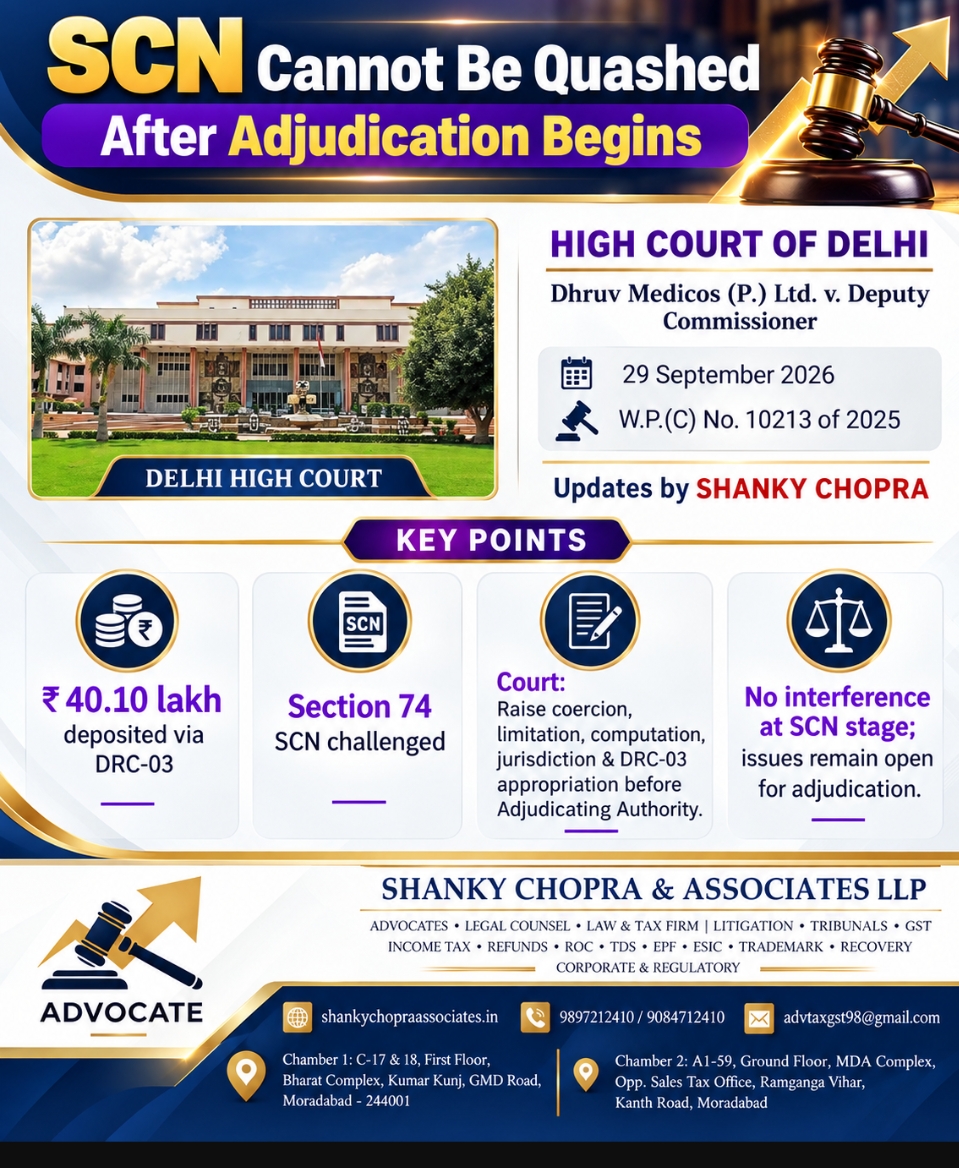
In *Dhruv Medicos Pvt. Ltd. v. Deputy Commissioner, Central GST Circle 5, Audit-I, Delhi & Ors.*, the Delhi High Court considered a challenge to a GST audit report and a show cause notice issued under Section 74 of the Central Goods and Services Tax Act, 2017. The judgment, pronounced on 29 September 2026, discusses the appropriate stage for raising objections and the role of the adjudicating authority in examining disputed tax demands. <Cite refs={["turn974711search0","turn974711search1"]}/>
The ruling is relevant to taxpayers, business owners, traders, distributors and professionals handling GST audit objections, tax demands and departmental proceedings.
## 1. Background of the Dhruv Medicos Case
Dhruv Medicos Pvt. Ltd., a company engaged in the distribution of medicines, was subjected to GST audit proceedings. The audit process commenced following the issuance of a notice in Form GST ADT-01 in September 2024.
During the proceedings, the company furnished documents and information requested by the department. An onsite audit was subsequently conducted at the company's premises in March 2025.
The company alleged that, during the audit, an amount of ₹40,10,153 was deposited through Form GST DRC-03 on 25 March 2025 under coercion. It disputed the circumstances in which the payment was made and maintained that the amount should not be treated as a voluntary admission of tax liability.
The department subsequently issued an audit memo proposing a higher liability, followed by an audit report dated 29 April 2025. The company also raised concerns about the calculation of the proposed demand and the availability of adequate supporting details.
Thereafter, the department issued Form GST DRC-01A and proceeded with a show cause notice dated 27 June 2025 under Section 74 of the CGST Act.
The company approached the Delhi High Court challenging the proceedings and seeking relief concerning the audit report, the show cause notice and the amount deposited during the audit. <Cite refs={["turn974711search0","turn974711search2"]}/>
## 2. What Is a GST Show Cause Notice?
A GST Show Cause Notice, commonly known as an SCN, is a formal communication through which the department informs a taxpayer of proposed action and provides an opportunity to explain why the proposed demand or other action should not be confirmed.
Depending on the applicable legal provisions and circumstances, a notice may concern tax allegedly not paid, tax short-paid, an erroneous refund or input tax credit issues.
A show cause notice is an important stage of the proceedings because it identifies the allegations and the proposed action. The taxpayer can submit a reply, provide documentary evidence, dispute the department's calculations and raise legal objections.
Importantly, **the issuance of a show cause notice does not, by itself, establish the final tax liability of the taxpayer**. The allegations and proposed demand must be examined through the applicable statutory process.
In the Dhruv Medicos matter, the Delhi High Court emphasised this distinction while considering whether interference with the notice was warranted at that stage. <Cite refs={["turn974711search0","turn974711search2"]}/>
## 3. Difference Between GST Audit and Adjudication
One of the important aspects of the judgment is the distinction between audit proceedings and subsequent adjudication proceedings.
A GST audit involves examination of the taxpayer's records, returns, documents and compliance with applicable tax laws. The audit may identify discrepancies or propose additional liability.
Adjudication is a subsequent statutory process in which the competent authority examines the show cause notice, the taxpayer's reply, supporting evidence and applicable law before deciding the matter.
The Court observed that the audit process had culminated in an audit report and that proceedings under Section 74 had subsequently been initiated through a show cause notice.
The taxpayer therefore had an opportunity to place its objections before the adjudicating authority. The Court declined to examine the underlying tax dispute at the preliminary stage of the writ proceedings.
For businesses, this distinction is important. An objection to an audit finding should not be abandoned merely because the audit report has been issued. Relevant objections should be properly incorporated into the reply to the subsequent show cause notice.
## 4. Importance of Section 74 of the CGST Act
Section 74 of the CGST Act, as applicable to the proceedings in question, concerns tax not paid, short-paid, erroneously refunded or input tax credit wrongly availed or utilised by reason of fraud, wilful misstatement or suppression of facts to evade tax.
Proceedings under this provision require careful examination of the allegations and the evidence relied upon by the department.
A taxpayer receiving a notice under Section 74 should examine:
- The specific allegations made in the notice.
- The legal basis for invoking Section 74.
- The relevant financial year and applicable limitation provisions.
- The calculation of tax, interest and penalty.
- The documents and evidence relied upon by the department.
- Whether amounts already paid have been correctly considered.
The taxpayer should respond to the actual allegations rather than submit a general denial. Each disputed issue should be addressed separately, supported by relevant records and legal grounds.
The correct legal position must be assessed with reference to the applicable statutory provisions and the facts of the individual case.
## 5. DRC-03 Payment and Allegations of Coercion
Form GST DRC-03 is used for making certain payments voluntarily or in response to applicable GST proceedings, as permitted under the relevant rules and procedures.
In the Dhruv Medicos case, the company disputed the circumstances in which ₹40,10,153 was deposited through DRC-03 during the audit. It alleged that the payment had been made under coercion and challenged its appropriation.
The Court did not decide whether the payment was voluntary or coerced. It expressly left that issue open for consideration by the competent adjudicating authority. <Cite refs={["turn974711search0","turn974711search2"]}/>
This aspect is particularly relevant for taxpayers who dispute payments made during an audit or departmental visit.
Where such a dispute arises, the taxpayer should preserve and submit relevant evidence, which may include:
- The DRC-03 form and ARN.
- The payment challan and bank statement.
- Correspondence exchanged with the department.
- Written objections submitted after the payment.
- The audit memo and relevant departmental communications.
- Documents showing the basis, or absence of a clear basis, for the proposed liability.
A taxpayer should clearly explain whether the amount relates to tax, interest or another component and how it should be treated against the demand under consideration.
A DRC-03 payment does not automatically settle every disputed issue. Its legal effect depends on the facts, the nature of the payment and the applicable provisions.
## 6. Limitation and Computation of GST Demand
Limitation is an important legal issue in GST proceedings. The department must act within the time limits prescribed by the applicable law, taking into account the relevant financial year, type of proceedings and any legally applicable extensions or special provisions.
Taxpayers should verify the dates of the relevant returns, the period covered by the notice, the date of issuance and the statutory provisions applicable to that period.
The computation of the demand must also be examined carefully. Errors may arise from incorrect turnover figures, duplication of amounts, credit already reversed, tax already deposited or an incorrect calculation of interest.
Where a taxpayer identifies an error, the reply should contain a clear reconciliation and supporting documents.
In the Dhruv Medicos case, the company raised objections relating to limitation, the computation of liability and other substantive issues. The High Court did not decide these issues on their merits; it left them open for consideration by the adjudicating authority. <Cite refs={["turn974711search0","turn974711search1"]}/>
Therefore, the judgment should not be interpreted as confirming that the proposed demand was correct or that the taxpayer's limitation objections were rejected on their merits.
## 7. Can a High Court Quash Every GST Show Cause Notice?
No. Whether a High Court should interfere with a show cause notice depends on the facts, the legal grounds raised and the applicable principles governing judicial review.
The existence of an alternative statutory remedy is an important consideration. Courts may decline to intervene where the statutory adjudication process is underway and the taxpayer can effectively raise the disputed issues before the competent authority.
However, the availability of an alternative remedy does not mean that judicial review is excluded in every case. The circumstances and recognised legal exceptions must be assessed individually.
In Dhruv Medicos, the Court found no reason to interfere with the notice at that stage. It permitted the taxpayer to raise all available objections before the adjudicating authority and clarified that it had not expressed an opinion on their substantive merits. <Cite refs={["turn974711search0","turn974711search2"]}/>
The decision is therefore best understood as a ruling on the appropriate stage and forum for examining the objections in that case, rather than a blanket rule that every GST show cause notice must be allowed to proceed without judicial scrutiny.
## 8. Practical Steps After Receiving a GST Notice
Businesses should take a structured approach when responding to GST notices.
**Step 1: Read the notice carefully.** Identify the financial year, statutory provision, proposed tax amount, interest, penalty and deadline for submitting the reply.
**Step 2: Obtain supporting documents.** Collect the audit report, relied-upon documents, return data, invoices, ledgers and departmental correspondence relevant to the allegations.
**Step 3: Reconcile the figures.** Compare the department's calculations with the books of accounts, GST returns, input tax credit records and previous payments.
**Step 4: Prepare issue-wise objections.** Address each allegation separately and explain the relevant facts, legal grounds and supporting evidence.
**Step 5: Account for payments already made.** Attach DRC-03 details, ARN, challans and a reconciliation of amounts already deposited.
**Step 6: Request a personal hearing where appropriate.** If required under the applicable provisions or necessary to present the taxpayer's case, make a proper request and retain proof of submission.
**Step 7: Preserve acknowledgement and filing records.** Maintain copies of the reply, annexures, portal acknowledgements and any subsequent communications.
A detailed and well-supported reply helps ensure that the taxpayer's position is properly placed before the adjudicating authority.
## 9. GST Legal and Taxation Assistance in Moradabad, Kanth, Noida and Delhi
Businesses facing GST disputes may require assistance with audit replies, show cause notices, input tax credit reconciliation, tax calculations, DRC-03 payments, departmental hearings and appeals.
Shanky Chopra & Associates LLP provides taxation and compliance support, including GST registration, return filing, audit-related documentation, GST notice replies, appeals, refunds, income tax services and corporate compliance.
Businesses in Moradabad and Kanth, Uttar Pradesh, as well as clients in Noida and Delhi, may contact the firm to discuss their GST compliance and dispute-resolution requirements, subject to service availability.
Professional assistance can help businesses organise their documents, identify relevant issues and prepare a structured response based on the facts and applicable law.
## Conclusion
The Delhi High Court's decision in *Dhruv Medicos Pvt. Ltd. v. Deputy Commissioner* highlights the importance of distinguishing between GST audit proceedings and the subsequent adjudication process.
The Court declined to quash the show cause notice at the preliminary stage and left questions concerning limitation, computation, jurisdiction, the audit process and the disputed DRC-03 payment open for consideration by the competent authority.
For taxpayers, the practical lesson is to respond to GST notices within the prescribed time, raise specific legal objections, reconcile the figures and submit supporting evidence. The outcome of an individual case will depend on the facts, the applicable statutory provisions and the findings of the competent authority.
**Legal Disclaimer:** This article is for general informational purposes and does not constitute legal or tax advice. The case-specific details and legal position should be verified against the official judgment and applicable legislation before being relied upon in any proceeding.
**Shanky Chopra & Associates LLP**
GST Compliance | GST Notice Replies | Taxation | Appeals | Litigation Support | Income Tax | ROC Compliance
Have Questions? We're Here to Help
Get expert advice from SHANKY CHOPRA & ASSOCIATES LLP. Reach out to discuss your requirements.